Wednesday, April 18, 2012

SPRING INTO THE WORLD OF COMICS... FOR A GOOD CAUSE!

Superheroes for Hospice promot

Greetings Scared Silly fans! It's springtime and that means it's time once again for the next “Superheroes for Hospice” charity comic convention, taking place this Saturday, April 21st at the Barnabas Health Hospice and Palliative Care Center (BHHPCC). The event takes place from 10AM to 5PM and benefits patients and families served by BHHPCC. I will be there autographing copies of my ARCHIE’S WEIRD MYSTERIES and VINCENT PRICE books along with various comic book projects.

Photobucket

New this year is the "Get Into Comics" lecture series. Comics historian and writer-artist Arlen Schumer will take the audience through an overview of his life loving and ultimately working in comics. Cartoonist Rick Parker will give a hands-on lesson in creating and sketching a comic book character. Hannah Means-Shannon, PHD will explore how the tradition of spectacular heroes goes back to ancient history as well as the place comic book heroes play in our society today.

More details on the event and the lectures can be found when you click on this link.

There will also be plenty of comics for sale from all decades to purchase as well as other great comics creators on hand to autograph comics, do sketches and sell original art. Among some of the great comics pros on hand will be famed Marvel and Papercutz artist Rick Parker, who is bringing "Tales from the Crypt" to a new generation; writer Erica Schultz, whose fine "M3" is quickly gaining a following and features the art of legendary horror comics artist Vincente Alcazar; and Dave Ryan, the man behind the all-star comic mash-up "The War of the Independents." And that's just a small sampling of the talent appearing this Saturday.

Midnight Marquee Actors Series Vincent Price

Established in 1981, Barnabas Health Hospice and Palliative Care Center provides comprehensive physical, emotional and spiritual care and support services to patients with advanced illness throughout ten counties in New Jersey. The program, which serves infants, children, adults and the elderly, honors the unique choices and values of patients and their families while offering full access to the broad array of services provided by the Barnabas Health. For more information, please visit www.barnabashealthhospice.org.

Now here’s a clip from the audio/video podcast, “Fever Keeps It Real” – the fine folks who run the show, Paul and Linda Wein dropped by the September “Superheroes for Hospice<” convention and interviewed me about Archie’s Weird Mysteries and the charity starting at 3:46 – enjoy!

Monday, April 16, 2012

THE THREE STOOGES: REIGNING CHUMPS… ER, CHAMPS OF HORROR-COMEDY!

Photobucket

This weekend a new movie opened with actors portraying characters based on the beloved comedy trio, The Three Stooges. There will be some who venture forth to see it while others will stay away. The film seems particularly targeted at children, and perhaps a positive outcome will be that some of those kids will end up being exposed to and loving the real Stooges’ shorts and features.

Since we’re all about the “classic” here I thought I’d take the opportunity to note that the Stooges hold the distinction of being the classic comedians who participated in the most “horror-comedy” scenarios. Between the innumerable spooky short subjects they made through the years (featuring the core two of Moe Howard and Larry Fine with third Stooges Curly Howard, Shemp Howard and Joe Besser) as well as some feature films (with Curly Joe DeRita as third Stooge) they easily outpaced their closest competitors, Abbott & Costello, Laurel & Hardy, the Little Rascals and The Bowery Boys when it came to the number of times they mixed laughs and scares. Add in Shemp’s solo appearances in horror-comedy projects and forays into horror territory on the 3 Stooges cartoon show (with live-action wrap-arounds) starring the DeRita incarnation of the team and the Stooges are the undisputed champs of the genre.

If you’d like to read about the “real” Stooges getting scared silly, just click here for a terrific article that gives a great overview of their horror-comedy films.

You can also access the reviews I’ve previously posted of some Stooges horror-comedy shorts when you click on the titles below:

IDLE ROOMERS

SPOOKS

OUTER SPACE JITTERS

Now enjoy this authorized “minisode” from Crackle, an abridgement of the classic Stooges short, “If a Body Meets a Body,” a semi-remake of “The Laurel-Hardy Murder Case.

Wednesday, April 11, 2012

BLUE LIKE JAZZ (2012)

Blue Like Jazz movie poster

NOTE: No, you didn’t accidentally type the wrong website address. No, you didn’t accidentally click on some obscure hyperlink sneakily buried like an Easter egg in the middle of this webpage. No, your browser hasn’t been hijacked, either. And no, you didn’t just step into The Twilight Zone nor have your monitor’s transmission taken over by the producers of The Outer Limits. You are indeed on the “Scared Silly” page, home of my blog-to-book project wherein I set out to review as many classic Hollywood horror-comedies as possible from the silent era through the mid 1960s. So why have I posted a review of a brand-new, 2012 film with ample doses of comedy but no evident horror elements? The answer is simple: thanks to a Kickstarter fund raiser that you can read about here, I am an Associate Producer of the new film, “Blue Like Jazz.” and was privileged to see an early screening. Here is my review.

RATING: *** & ¼ out of ****

PLOT: Young Don is an assistant youth pastor in Texas facing several conflicts. His first conflict: a devout mother pushing him toward a Christian college education versus his vagabond-professor dad, estranged from his Mom and pulling strings to get him into one of the top liberal arts colleges in the country. His second conflict: when two people Don admires let him down – including most significantly his mother – he eschews his faith and decides to dive head first into the liberal arts college his dad endorses. But it’s not just any liberal arts college – it’s Reed College, where all bets are off The first day of school, the dean instructs his students to “forget everything” they’ve ever learned about anything. This especially includes matters of religion. Don sets out to “ditch God” in his freshman year but a series of events involving some of Don’s new friends force him to reassess and perhaps abandon his mission. Will Don’s life, his response to the faith in which he was raised and the way he treats others “resolve” or remain forever like “stars swirling in the blue,” unresolved like the freeform jazz albums to which he often listens?

REVIEW: “Blue Like Jazz” is based on the best-selling NY Times book of the same title by Donald Miller. The book is a rather freeform collection of autobiographical essays detailing the author’s struggles with faith, specifically the Christian faith, his belief in God and in Jesus and how he often had trouble reconciling the loving, graceful, merciful Jesus he read about in the gospel accounts of the bible with some of the contradictory, hypocritical attitudes he encountered along the way (including often his own) as he set out to live his faith. A large portion of the book relates tales of Miller's time auditing classes at Reed College, a liberal arts school in Portland Oregon.

The film is directed by Steve Taylor, who directed one previous feature film (2006’s “The Second Chance,” another favorite of mine) and recorded many music albums as a singer-songwriter-musician producer both within and outside of the Christian music industry. He made the natural segue from directing his own music videos and those of others to directing movies. Depending upon your viewpoint, Taylor is famous or infamous for his penchant to hold up an often bitingly satirical mirror to some of the uglier, more hypocritical examples he’s seen come from some church leaders and members through the years.

Both the book and movie of “Blue Like Jazz” exist I believe as an attempt to serve as a bridge between believers and non-believers to help them better understand one another. The book may have started as Donald Miller’s personal journey to resolve the conflicting feelings about Christianity within his own heart but in adapting it to a screen story where others’ conflicts, motives and deep personal feelings are also revealed the idea of reconciliation may ring even more true.

The film is very funny in spots, involving and thought-provoking. There is some genuine drama. In the end, it’s about how the characters respond to each situation and to each other, and how all those pieces relate to the bigger picture that form the heart of the film. In that way, this is one of those stories where the destination reached may be more important than the particulars of the journey along the way.

It’s worth mentioning the main characters and the actors that play them. Front and center of course is the semi-fictionalized version of the book’s author, Don Miller. Marshall Allman, known for his recurring roles in the TV series “Prison Break” and “True Blood” plays Don. His acting in the early scenes comes off just a tad uneven, but perhaps it was a conscious choice given the changes his character goes through. Ultimately he handles some tougher scenes toward the film’s end quite admirably and redeems himself, just as his character does the same.

William McKinney is Don’s friend Jordan from Texas. The two work at a plant that manufactures disposable communion cups pre-filled with grape juice (they look a bit like coffee creamers). Jordan starts as a bit of a ruffian poser but through a funny though perhaps unlikely situation goes through an extreme character change. Something that really changes his life in an impactful way and gets Don thinking a bit. Jordan's turnaround is the flipside to Don’s character starting out as believing in principles then giving way to reckless abandon in the face of adversity. Jordan's character adds an extra piece to Don’s puzzle of (re?)self-discovery.

Another pair of students at the school nicknamed “The Pope” (Justin Welborn) and “The Russian” (Matt Godfrey) are broad types at first (even within a scene where the college characters discuss archetypes vs. stereotypes in literature class – kind of an unintentional act of “meta”) but they eventually become more shaded characters into which the audience gets an extra glimpse of understanding. So much so that both figure prominently into the film’s ending.

There are two pairs of prominent non-student adult figures sprinkled into the mix as well, and they act as bookends for each other. On one side are Don’s mother (Jenny Littleton) and the head youth pastor Kenny (Jason Marsden). They are hiding behind self-righteousness and hiding some other things as well (their flaws come to the surface soon enough). On the other side are Don’s dad (Eric Lange) and the school’s dean (Jeff Obemi Carr). They aren’t hiding at all but rather flaunt their notion that they “know it all” with such certainty that you suspect the other shoe may drop one day and they’ll realize they’re only fooling themselves.

The two characters viewers may remember most are the two female leads. The combination of how the characters are written, the struggles they endure and the performances by the actresses that play Penny and Lauryn make them engaging, endearing and embraceable.

Penny (Claire Holt, “The Vampire Diaries”) factors in as the main catalyst toward Don reassessing the path of rebellion he’s been on and more importantly, encouraging him to redirect his gaze from inward to outward. Through Penny’s example, Don realizes that he needs to reach out more to others instead of constantly reaching in to fulfill his own needs. Penny gradually reveals herself and her true motivations. She is the model of grace toward Don even (and especially) when he seems none too deserving for his thoughtless actions. She becomes the true heart and soul of the movie, although she does have some company in the other female lead, Lauryn.

Blue Like Jazz Lauryn

Lauryn (Tania Raymonde of “Malcolm in the Middle” and “Lost”) is a lesbian in a film made by Christians in which her character is not there for any other reason than to display love. First, in a great “flip” to how other screenplays may have handled a straight-gay relationship, it is Lauryn who is the first to befriend Don on campus. Although one can argue that her advice to “stay in the closet, Baptist boy” shows a lack of acceptance on her part, it’s only given because she knows the ropes of the place and is trying to protect Don from being immediately thrown to (and devoured by) the lions. Later in the film it is Don who shows love to Lauryn, comforting her during an emotionally difficult time for her. The Lauryn character would probably slap me for saying so, but Raymonde’s performance is radiant and easily makes her the biggest candidate for “break-out” status here.

Steve Taylor honed his behind-the-camera skills by directing music videos for his songs and those of others. This MTV-style of short, dynamic cuts serves him better in “Blue Like Jazz” than it did in “Second Chance.” Probably because it fits the chaotic, “anything goes” world of college partying and self-exploration shown in “Jazz” than it did the gritty realism of “Chance’s” inner city scenes.

Beyond the quick cuts we get a lot of of close-ups which is understandable due to the film’s low budget as well as the fact that it is a personal story revolving around people’s feelings rather than explosions and special effects. However, these alternate with some interesting visuals courtesy of the built-in conceit of the real Reed College’s famed “Renn Fayre.” This annual festival of debauchery takes place after final exams and is complete with students dressed in a variety of crazy costumes.

In fact, costumes become something of a theme in “Blue Like Jazz” as if Taylor really wanted some visually compelling images to adorn this introspective tale. Other examples are the Pope character that is clothed as his namesake throughout and a scene of “civil disobedience” in a bookstore that finds the students dressed as robots and astronauts (it’s telling that this particular protest by sweet Penny revolves around the notion that chain bookstores make it harder for less known indie writers to get read).

Blue Like Jazz Astronaut Robot

The animation fan in me is sated by the inclusion of a cleverly inserted scene that brings Miller’s cartoon strip story from “Blue Like Jazz” (“Don Rabbit and Sexy Carrot”) to life. A metaphor for Don (or anyone) relentlessly chasing after ill-conceived desires despite the danger that lies ahead, the scene is effectively inserted at a point in the story where Don makes a crucial decision.

The film is not without its flaws, but after reading the writings and interviews from the folks behind it I think they’d be disappointed if it didn’t have flaws, since having flaws is a big point of the story in the first place. I don’t think those flaws – minor at best - mar the film or lessen its impact. The biggest criticism I had when I first saw the film was that it appeared the filmmakers may have gone so out of their way to not appear to be playing favorites that they gave more “face time” to views that oppose Christianity as opposed to equal time to both views. After seeing the film a second time I changed my mind. Between the life-changing experiences of both Jordan and Penny and Don, especially those depicted in the very powerful third act I can honestly say I was wrong and that there is a real balance here.

I've read some reviews that call out the film's quirky humor as being "unrealistic" and compromising the drama of what the characters go through. I am reminded though of Wes Anderson's brilliant "The Royal Tenenbaums," filled with quirky humor yet also resonating with some affecting drama. I believe the "Blue Like Jazz" team pulled off a similar feat.

This film is rated PG-13. I would consider it a "hard PG-13" - it is very edgy and adult. It draws primarily from the parts of the book revolving around the no-holds-barred liberal arts college that author Miller attended (most of the action is set there). While I was never the party guy in college (for a variety of reasons) or even after college, these elements don't personally bother me so much as I realize that the filmmakers were trying to tell their story authentically and not potentially mute their message by whitewashing the context in which the story takes place. Context figures heavily into what is perhaps the film’s most controversial line of dialogue.

The line is the character Don saying, “I’m ashamed of Jesus.”

The line as it appears in the trailer, removed from its context, makes for a highly provocative statement that leads a viewer to wonder why the lead character would express this thought. However, when seen within the context of the entire scene and really the entire film, it becomes clear that Don is really saying he’s ashamed of himself. He says that once he realized who Jesus really is and what he requires of his followers, he and many other professing Christians simply missed the boat and have misrepresented Jesus.

This is one of those “mirror reflection” revelations that stings. Don makes a particular point of confessing that he’s never helped the poor, a key tenet of the faith, but instead bought into political movements and other distractions that kept him off-point. Don also owns up to his actions, confessing that he has indeed been consciously "trying to ditch God" his entire freshman year of college. It is through the examples of other characters and various situations that arise that Don comes to realize that the more he pulls away, the more Christianity is tugging at his heart. To embrace it, he concludes that he’s got to reach out to others (even and especially those that don’t share his beliefs) in a spirit of love and reconciliation.

Blue Like Jazz Spider Web

This movie really resonated with me. I was raised in a nearly-idyllic small town in New Jersey. I was brought up Catholic but my evangelical friends got me into VBS and the Christian version of Boy Scouts at their church. By the time high school came around I was not only going to youth group but regularly attending a non-denominational bible church. The left turn came when I found myself going to college at one of the nation’s most renowned art schools. In New York City no less! Talk about culture shock. I can certainly attest first hand to the edgy content in “Blue Like Jazz” being authentic to a college experience.

The other way the film resonates with me is through Don’s shame. I admit that I too have been guilty of mistreating others even while convinced I was doing the right thing, the thing I thought God wanted me to do, think or say. Christ’s example – and the lesson Don learns in the film – is one of sacrifice of self in the interest of others. How will what I do/say/think affect the other person? It’s always the simple lessons in the bible – the ones so easy to forget or that we try to modify to fit our own selfish needs – it’s always those simple lessons that humble us and bring us back home to true loving behavior. Love your neighbor as yourself, don’t tear down others with harsh words, forget about that splinter in your neighbor’s eye and concentrate instead on removing that mega-high skyscraper girder from your own eye.

I do have to underscore here that families looking for the next “Facing the Giants” need to look elsewhere. By director Steve Taylor’s own admission, “Blue Like Jazz” is not a “family-friendly film.” It’s not even a “Christian film” in terms of how that phrase is used to market a certain “brand” of film that’s become defined by staying within certain parameters. “Blue Like Jazz” is an indie film from an indie film distributor, made by Christians with Christian themes as well as explorations of other viewpoints. It is meant to reflect real-life. Real life is messy for everyone no matter what their beliefs.

“Blue Like Jazz” is a film that pulls no punches. More than any other film about Christianity I've ever seen it's one I believe non-believers can enjoy and perhaps even embrace. Perhaps it will inspire believers and non-believers to be brought to a place of reconciliation where at least a civil dialogue can be had. I don't think every non-believer who sees this will embrace Christianity - I don't expect them to do so - but at the basic level of coming to a place of better understanding between those who believe differently from one another it's certainly a conversation starter and a step in the right direction. Just like Don apologizing for the Crusades in the movie’s dramatic confession booth finale.

“Blue Like Jazz” opens in theaters nationwide on Friday, April 13, 2012. Click here to find out where it’s playing in your area.

Thursday, March 29, 2012

THE LAUREL-HARDY MURDER CASE (1930)

Laurel-Hardy Murder Case title card

RATING: *** out of ****

PLOT: Out of work and out of options, Stan Laurel and Oliver Hardy while away their time fishing at the dock. They can’t even catch fish right, of course! When Ollie notices the newspaper meant for fish-wrap contains a little classified ad summoning the “heirs” of the three million dollar Ebeneezer Laurel estate to the reading of the will, it appears the boys’ fortunes may soon change. Change they do… but not necessarily for the better. A spooky old mansion filled with eccentric help and even more eccentric relatives, the matter of the inheritance is sidetracked when it’s revealed that old man Ebeneezer was murdered! Now everyone’s on lockdown and Stan and Ollie aren’t sure what they’re afraid of most: the dark shadows, the bats flying through the house, ghostly bed sheets levitating over their heads… or their own shadows!

PREFACE: It’s not often that I precede a review with a special note, but I must do so in this case. This film was the favorite Laurel & Hardy film of my dear, departed friend Allen Schottenfeld. A member of the same “Sons of the Desert” tent to which I belong (for the uninitiated, the “Sons of the Desert” is the International Laurel & Hardy appreciation society), Allen often cited “The Laurel-Hardy Murder Case” as his favorite Stan and Ollie romp. In fact, he was videotaped at least once making that same declaration. Allen referred to this film as “a wonderful spoof,” and it is to Allen that the book version of “Scared Silly” will be dedicated.

REVIEW: Laurel & Hardy had only been a little over a year into their talkie careers when they decided to revisit the scare comedy antics they delivered in their silent classics, “Do Detectives Think” (1927) and “Habeas Corpus” (1928) As many of the boys’ films were at this time, “The Laurel-Hardy Murder Case” is a mix of brilliant comedy with some awkwardly-timed moments (the team hadn’t yet fully hit their stride in sound films, although they very shortly would).

It is telling that when Stan and Ollie have the screen to themselves (as in the first scene at the docks as well as some later scenes in the bedroom) they shine much more than those scenes they have to share with the supporting cast. Perhaps it was just that they were so comfortable with one another that they knew exactly how to play their bits of business and could certainly improvise their way through a scene. This was much harder to do when interacting with the supporting casts, having to read the lines straight so the others would know their cues.

This is also one of the first Laurel & Hardy films where Stan & Ollie had to interact with a number of other characters simultaneously, as opposed to a stock situation like the duo directly taking on one of their regular foils like James Finlayson, Billy Gilbert or Walter Long. A good example is the silent classic, “Big Business.” Once the tit-for-tat war begins between the team and Finlayson, the three are the sole focus. There are onlookers to the wanton destruction but they are not active participants. In “Murder Case” the scenario is a little more complex, and naturally so being a more precise mirror of then-recent films that would influence what would come to be known as being in the “Old Dark House” genre (including early film adaptations of Charlie Chan and Philo Vance detective stories as well as more blatant horror-comedy fare such as the original silent versions of “The Bat” and “The Cat & the Canary”). The film it resembles most though may be “The Old Dark House” – which is amazing in itself because “The Laurel-Hardy Murder Case” predates James Whales’ classic feature by two years! If a viewer didn’t know the release dates, they would swear the Laurel & Hardy short is a direct spoof of “The Old Dark House!” Instead, it merely paid good attention to those above-mentioned drawing room murder mystery stories that had been proliferating in both books and on the stage and slowly made their way into cinema. To spoof such material properly, screen time has to be given to the other characters in addition to Stan and Ollie. More often than not, these detours in “Murder Case” slow the film down.

Having said that, this short starts off with pure Laurel & Hardy magic, with a funny and charming scene at the dock. One of the great H.M. Walker title cards gets things started with “Mr. Laurel and Mr. Hardy decided that they needed a rest – they had been out of work since 1921.” The site of Ollie sleeping against a dock post while Stan gleefully fishes is enough to bring a smile to the face of any long-time Laurel & Hardy fans. Ollie’s rest is of course soon disturbed by Stan, who has placed the fish he just caught beside him, where it flails wildly beneath Ollie’s backside, waking him up! I’ve seen quite a few of their films with audiences, and they are two of the few performers I’ve witnessed get laughs simply by being on screen. Of course, it’s much more than that, since it’s the personalities that elicit the laughter. When Stan snags Ollie’s hat on the fish hook and sends it into the bay, Ollie is especially flustered (especially after getting a face full of water). Of course, these little bits of business also serve the purpose of setting the plot into motion. When Stan crumples up the newspaper he’s been using as fishwrap and tosses it out, the wind blows it right into Ollie’s face, where he reads the “legal notice” that “the heirs to the $3,000,000 estate of the late Ebeneezer Laurel” are being summoned to Laurel Mansion for the reading of the will (the classified ad is attributed to “L.A.H.” – .an in-joke evoking “Laurel and Hardy,” of course).

Using only Stan’s surname as his proof, Ollie ascertains that Stan must be one of the heirs. A hilarious early example of how the Stan and Ollie characters adapted to sound follows (you can read the dialogue below in the “Best Dialogue Exchanges” section). Ollie’s vocal intonations underscore his high opinion of himself. As Hardy (the actor) once explained, Hardy (the character) is “the dumbest kind of dumb guy there is… the dumb guy who thinks he’s smart!” Ollie’s voice indicates that he his pleased with himself and his (alleged) intellect in determining Stan is in line for an inheritance. Meanwhile, Stan’s speech patterns and dialogue are a combination of whimsical innocence, blank confusion and the occasional attempt to be bold. While hardly news to most of those reading this review, the duo’s ability to find “the perfect voices” for their characters not only made their transition to sound easier than the reigning silent comedians Chaplin, Keaton and Lloyd but actually enhanced their comedy. Consequently, their popularity was enhanced and they were catapulted into international superstardom. All the while, the duo held a reverence toward the physical comedy tricks they learned in the silents. They utilized sounds and dialogue as necessary but just as often their talkies contained stretches where no dialogue was spoken. The sound served to make their characters even more full-blooded than they already were, but was not the main component of what endeared them to the public.

After the whimsical opening bit we get down to horror business. An establishing shot of the mansion, standing forebodingly in the middle of a thunderously frightening rain and wind storm (of course) sets the tone. Inside the home, a cast of suspicious characters has gathered in all their Earl Derr Biggers-inspired drawing room glory, anxiously awaiting the reading of the will. They include an old man and woman, an ingĂ©nue, a dapper young man and a stern middle-aged fellow. Also on hand are a creepy old butler and a matronly maid who just seems a little bit “off.” Last but not least, a derby wearing detective and his men are on the scene. When the old woman asks what time the will is scheduled to be read, the detective answers, “sorry to disappoint you old dear, but there ain’t gonna’ be no reading of no will!” When further pressed as to why they’re all there if the will won’t be read, the detective proclaims, “You’re here because Ebeneezer Laurel didn’t die a natural death… HE WAS MURDERED!”

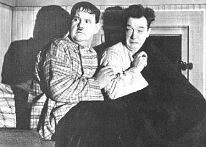
Fred Kelsey Laurel-Hardy Murder Case

The detective must be singled out here. In this short, Laurel & Hardy receive great support from the rest of the cast, but one performer in particular is a standout: Fred Kelsey. Kelsey’s role as the gruff detective on the case actually became an archetype. He would play the role again several times in both straight horror films (“The Invisible Ghost” with Bela Lugosi) and horror-comedies (The Three Stooges’ “If a Body Meets a Body,” a semi-remake of “The Laurel-Hardy Murder Case”). His character traits became so identified with a certain type of detective that soon others began imitating him and master animation director Tex Avery even did a direct spoof of Kelsey (in the classic cartoon, “Who Killed Who?” from 1943). His character was personified by wearing a suit complete with timepiece in pocket, a derby upon his head and two thumbs with which he often tugged at his lapels. Sometimes he chomped on a cigar; often he shouted out pronouncements of guilt with little or no facts to go by; always he had his bravura on display! In addition to his pronouncements, Kelsey had a way of pausing during his statements that was very comical. For example:

“Now get this, folks (PAUSE) I’ve got a hunch that Ebeneezer Laurel was murdered (PAUSE) By a relative (PAUSE) So that said relative (PAUSE) will come into all his dough!”

His visual flourishes matched his approach to dialogue. When a burst of wind blows through the window and knocks over a piece of furniture and a lamp. Kelsey does a wonderful, startled take and then locks the window shut. He also knew how to combine the verbal and visual to convey a “is that so?!” style – for example, when one dapper relative tries to leave the mansion citing “two theater tickets” the detective takes the tickets, rips them in half and asks his deputy to “show this gentleman to his seat!”

Making the trio a quartet is Frank Austin as the butler. Austin had a lengthy career doing character parts in films of all genres (playing in everything from “The Mystery of the Wax Museum” to “Mr. Deeds Goes to Town/Mr. Smith Goes to Washington,” as well as appearing alongside such other comedy legends as W.C. Fields, The Three Stooges and Olsen & Johnson. He popped up in several Laurel & Hardy shorts and features including an uncredited part in “Babes in Toyland” (aka “March of the Wooden Soldiers”) playing the justice of the peace who thinks he’s marrying Barnaby to Bo Peep (really Stan in disguise). His pliable face, cragged with a dour expression made him the perfect “mysterious” character whether being played straight-up or for laughs. He often played butlers, and in “Murder Case” he pulls out all the stops – a menacing laugh, a twisted facial expression and an ominous tone all combined to send shivers down Stan and Ollie’s spines… and sent moviegoers into fits of laughter!

When Stan and Ollie arrive at the mansion, they are no more above suspicion than the motley crew of Laurel relatives already gathered there. Told that they can’t leave, Ollie protests that the detective can’t possibly think he and Stan had anything to do with the murder. “I’m not saying,” the detective replies, “…but I believe that the criminal always returns to the scene of the crime,” he underscores. This is of course delivered in the stock blustery Fred Kelsey manner as described above, along with the imposing warning, “Don’t any of ‘ya try that escape stuff, ‘cause the house is surrounded!”

Before being beset by the detective, the butler and the scares that await them, Stan and Ollie show that they are their own worst enemies. The first sign of trouble is revealed in this exchange:

OLLIE: What a beautiful home, and what luxury! And to think, it’s all ours!
STAN: Whaddaya’ mean “ours” – it’s mine!
OLLIE: There you are – just like all the rest of them. Sitting on top of the world and turning down your best pal – your benefactor!

Ollie makes a pompous show of being dejected and feigns resignation, going through the motions as if to leave. His desired result is of course to guilt Stan into keeping the partnership intact and to make certain that Ollie “gets half of everything that’s coming” to Stan. Initially, it doesn’t work.

“Are you really going?,” asks Stan. When Ollie answers affirmatively Stan gives him his umbrella so he won’t get too wet on his way home!

The above theme of Stan & Ollie grieving over the possibility of splitting up because one or the other comes upon good (or bad) fortune would be a running gag not just throughout this short but also in other Laurel & Hardy shorts and features. For example, when released outside of America, the two-reel short “Laughing Gravy” was extended to three reels with the addition of a sequence that was almost exclusively about Stan coming into money and considering leaving Ollie behind. The bit comes off a bit more developed in “Laughing Gravy.”

Stan and Ollie are brought to a room where they are to spend the night. Everything in the room is covered by a sheet, and when Ollie asks the butler why, he gets the ominous response: “This is the room where the old man was murdered,” the butler sinisterly and gleefully reports. (Of course, astute viewers of classic comedy know the real reason for the sheets is to set up some ghostly gags later where the boys can mistake innocent inanimate objects for hostile spirits). To further unnerve our heroes, he points to the closet and dramatically adds, “His body was found in that cupboard!”

Stan and Ollie are visibly scared by the butler’s revelation, and it’s these little moments in all Laurel & Hardy films that show how special the team is. They don’t use dialogue, they’re not even using a wild take here, they are just showing that they’re scared using their facial expressions while at the same time staying completely in character. This ability to inhabit their characters 150%, to be fully immersed in “Stan” and “Ollie” is a trait that even some of their classic comedy peers of the ‘30s and ‘40s couldn’t match, And then, just as the butler has the boys where he wants them he delivers this killer coda: “Goodnight, gentlemen. I hope you have a nice, looooonnnngggg sleep,” he menacingly intones.

Well, they’re doing anything but sleeping as they encounter what are only the first of a series of scares they’ll face throughout the short. Typically, they begin by scaring each other. When Stan looks under the bed sheet, Ollie thinks it’s a ghost. When Ollie gets tangled in a bed sheet, he thinks a ghost is out to get him. Their self-scaring shenanigans are interrupted by a mysterious rapping…

A hand is seen on the edge of Stan and Ollie’s bedroom door creepily (and creakily) opening it from the outside. It is revealed to be that of the butler. He eerily asks, “Is everything all right?” The butler is simultaneously comical and creepy in the best horror-comedy tradition… and then becomes downright unnerving when he bares his long bottom row of teeth as if he’s half horse or donkey!

Laurel-Hardy Murder Case butler

More scares follow. Among them are unsettling scratching sounds, screeching black cats hiding in closets, their eyes glowing in the dark; and a painting of the Grim Reaper with a scary skull’s face, revealed when a sheet covering the canvas comes down. This last bit is pretty startling and effective; it’s easily the most unnerving image ever to appear in a Laurel & Hardy film.

After these initial scares, we are brought back to the running gag about Ollie wanting half of what Stan has coming to him. It seems Stan’s been so rattled he’s had a change of heart: instead of Ollie getting half of everything, Stan says he can have it all! It is one of those “comes the dawn” moments that the Stanley character occasionally has – here he knows full well that being a Laurel is not the safest thing to be at the moment!

There’s an interesting contrast in the use of the expression “dead men.” Ollie, trying to reassure Stan there’s nothing to fear says “dead man can’t hurt you.” The villains of the piece, justifying their decision to do away with Stan and Ollie (whom the butler refers to as “those shabby gentlemen”) reason that “dead men tell no tales.”

We are treated to an extended sequence of Stan and Ollie being scared witless. Many horror-comedy trappings are trotted out as well as a plethora of funny gags. They really are best experienced seen and heard rather than read about here, but I’ve done my best to sprinkle the details throughout the review and in the “Best Visual Gags” section. It is these delightful moments of Stan and Ollie in full-on terror mode that make this short a much-see and make up for its slow, dull patches.

Some real menace rears its head again when the butler tells the man with the theater tickets that he’s “wanted on the phone… downstairs in the library room.” We see the man enter the room, take a seat and lift the receiver and the… the lights go out and the man screams! When the detective runs into the room to check it out, the man is gone! This sends everyone into a panic, including the detective who can’t figure out what happened. Stan tells Ollie he’s going back home because he “can’t relax” but when he sees the others holed up in the hallway he gets scared (as do they) and all go running back into their rooms. Stan’s pounce back onto the bed (where Ollie is cowering under the covers) sends the mattress to the floor, leading to further hysterics!

The butler continues to send various guests down to the library room with similar results – a blackout, a scream, and then the disappearance of the guests. Ollie, in a moment of bravery says he’s “had enough of this” and declares that he’s “gonna’ find out what it’s all about!” Stan follows along and this leads to one of the short’s most hilarious moments, as Stan’s belt becomes entangled on the cord from a lamp obscured by a white sheet. Naturally, when he walks, the sheet-covered lamp follows his every move like a ghost! Ollie sees it and gets tangled with it, too. As Stan runs down stairs ensnared Ollie follows and the two come crashing to the bottom. It is an extended, hysterical sight gag as Stan is certain he’s either on the trail or being followed by ghosts!

Typically for a Laurel & Hardy short, the audience is only given a brief respite to catch their breath from all the laughter, as no sooner are Stan and Ollie sent back to their room than more craziness occurs. A bat flies into the bedroom and under the bed sheet. When Stan and Ollie get under the covers the sheet goes flying up like a ghost, levitating above them! Needless to say this sets off pandemonium as the boys once again run out of the room, into the hall and down the stairs. The detective and all his deputies run up the stairs to check out the commotion but when they see the sheet seemingly flying on its own, they run right back down the stairs again!

Laurel-Hardy Murder Case maid

The ending is one that fans have often debated. Or rather, the endings, plural. Stan and Ollie actually (accidentally) do something right for a change: investigating the desk and phone in the library room, they discover that the phone activates the trap door… but instead of Ollie being deposited wherever everyone else has been dumped the chair malfunctions and simply rises back up with Ollie in it. The duo are then besieged by the the maid, and during their tussle they rip off the maid’s wig, exposing the “she” as a “he.” But then… we dissolve into Stan and Ollie on their fishing pier, newspapers in hand, wrestling each other. It was all “just a dream!” Your ability to go with this is really dependent upon how you feel about dream endings in general. Fans of b-movie horror and horror-comedy films such as “The Corpse Vanishes” and “Sh! The Octopus” have bemoaned their “only a dream” endings as unimaginative copouts. Somehow, in the hands of Laurel & Hardy, it somehow feels okay, especially after the general wackiness that takes place for most of “Murder Case”’s running time. The duo would revisit the “dream ending” much less successfully in their later horror-comedy, “Oliver the 8th.”

This short is peppered with a lot of little touches that Laurel & Hardy fans love – Stan’s cry and whimsical way with words and concepts, Ollie’s blustery pronouncements (“why don’t you be careful!”) and heightened histrionics (“get the light… get the light!”) and in general, the duo’s ability to draw from a vast collection of facial expressions and body language to express everything from anger to fear, confusion to certainty (albeit often mistaken certainty) and so much more. It also features the first instance of Ollie uttering what would become one of his most-imitated trademarks, “well, here’s another nice mess you’ve gotten me into!” It provides an early showcase for comedienne Dorothy Granger who would go on to appear in several Laurel & Hardy shorts and also co-star with everyone from W.C. Fields to The Three Stooges to Leon Errol to Abbott & Costello (she also had a featured role in the Walter Catlett horror-comedy short, “One Quiet Night”). Fans can also enjoy erstwhile Chaplin and Laurel & Hardy foil Tiny Sanford in “Murder Case.”

With all of the above going for it, it is interesting then that many of those same fans as well as Laurel & Hardy historians generally have a lower opinion of this short. It is true that “The Laurel-Hardy Murder Case” isn’t flawless, but I have had opportunities to see it with a group and it has always played well in that setting. Considering that it was intended from the start to be seen with a group perhaps that is how it should be judged – on its ability to please an audience of more than one.

SPOTTED IN THE CAST – Lon Poff specialized in playing old men… for over 20 years! However, his full career in movies actually spanned 34 years, having started in silent. 1930’s old man role in “Murder Case” was one of his first septuagenarian gigs. He made his final appearance in 1951’s “Father’s Little Dividend”… playing an old man! Like famed comedian Andy Clyde, he ultimately, naturally grew into the role with little or no makeup required. Notable credits included such silent classics as “Dante’s Inferno” and “The Man Who Laughs” (with Conrad Veidt’s title performance cited as an influence on Bob Kane’s Batman-nemesis, The Joker) along with such sound-era fare as “Tom Sawyer,” “House of the Seven Gables,” “Sullivan’s Travels,” the “Flash Gordon” serial and “Joan of Arc.” On the comedy front he appeared with Laurel & Hardy previously in “Two Tars,” with Charley Chase in a trio of shorts including “Isn’t Life Terrible,” “Long Fliv the King” and “Calling All Doctors;” and with Wheeler & Woolsey in “Diplomaniacs” and “The Rainmakers.”

BEST DIALOGUE EXCHANGES:

By default the memorable piece of dialogue has to be the first use of “Well, here’s another nice mess you’ve gotten me into” but there are of course other gems here:

OLLIE: Where were you born?
STAN: I don’t know.
OLLIE: Fancy not knowing where you were born!
STAN: Well I was too young to remember!

OLLIE: Didn’t you once tell me that you had an uncle?
STAN: Sure I’ve got an uncle. Why?
OLLIE: Is he living?
STAN: No. He fell through a trap door and broke his neck.
OLLIE: Was he building a house?
STAN: No, they were hanging him!

STAN (after reading what the Laurel estate is worth): Three million dollars. Is that as much as a thousand?
OLLIE: Well man alive it’s twice as much!

(great dialogue underscores the Ollie character dynamic – as Hardy himself often explained, his character was “the dumbest kind of guy there is – the dumb guy who thinks he’s smart)!

DETECTIVE: Say you – where were you on the night of November the 15th?
STAN: The day before Christmas?
DETECTIVE: No, the day after Christmas! November the 15th!
STAN: November? (thinking out loud) Septober, Octember, Nowonder…

OLLIE: Well, here’s another nice mess you’ve gotten me into!
STAN: Whaddaya’ mean I got you into?
OLLIE: Well your name’s Laurel, isn’t it?
STAN: Well only on my mother’s side.

BEST VISUAL/VERBAL COMBO GAG:

DETECTIVE: Are you sure you’re a Laurel?
OLLIE (pointing to painting on wall): Why sure? Sure? Why, can’t you see the family resemblance?
DETECTIVE: Yeah, that happens to be General Grant!
OLLIE: Why of course it’s General Grant! His son and I belong to the same alma mater! Meaning Delpha Phi Delta. Rah rah rah, rah rah rah, sis boom rah!

BEST VISUAL GAGS:

Stan snags Ollie’s derby on the fishhook and sends it into the water. Pulling it back up, Ollie angrily snatches the hat from Stan and puts it back on his head… water and all!

Stan and Ollie arrive. Stan tries to close the umbrella but only opens it inside out!

Stan’s places his quivering hand on Ollie’s shoulder and Ollie gets frightened by it.

Stan accidentally drops a lit candle down the back of Ollie’s pajamas.

Stan lifts his nightshirt over his own head and gets stuck, flailing about in comical fashion.

BEST COMBO VERBAL/VISUAL GAGS:

DETECTIVE: Are you sure you’re a Laurel?

OLLIE (pointing to painting on wall): Why sure? Sure? Why, can’t you see the family resemblance?

DETECTIVE: Yeah, that happens to be General Grant!

OLLIE: Why of course it’s General Grant! His son and I belong to the same alma mater! Meaning Delpha Phi Delta. (Ollie does cheerleader style motions): Rah rah rah, rah rah rah, sis boom rah!

FURTHER READING: There are so many great Laurel & Hardy books out there that it’s a shame to pare down the list, but as far as “The Laurel-Hardy Murder Case” is concerned there are two that stand out. One is a handsome coffee table book simply called "Laurel & Hardy" by John McCabe and Richard W. Bann that I borrowed from my local library on nearly a continuous basis as a child. The book is loaded with both production and promotional stills from nearly all of Laurel & Hardy’s shorts and features, with a synopsis of each film and in some cases interesting background information. If more detailed background information is more your thing, then you’ll want to move directly to Randy Skretvedt’s essential, impeccably researched “Laurel & Hardy: the Magic Behind the Movies.” Both books have entries on “The Laurel-Hardy Murder Case,” as does this entry which was part of a fantastic overview of the majority of Laurel & Hardy’s horror-comedies from the Missing Link website.

BUY THE FILM: Well, after years and years of Laurel & Hardy fans pining for the best of the boys to be released on DVD, the wait is over! The “Essential Laurel & Hardy Collection” is just that, collecting the majority of the duo’s shorts and features that were produced at the hal Roach Studios, including “The Laurel-Hardy Murder Case.” You can order it when you click here.

If you still have a working VHS player you can get “The Laurel-Hardy Murder Case” and a few other classic Laurel & Hardy horror-comedies together in one videotape collection called THE LAUREL & HARDY SPOOKTACULAR. You can buy it here:


WATCH THE FILM: Since this is a short, there isn’t a trailer available but you can enjoy a brief sequence right here:

Friday, March 23, 2012

A FUNNY FRIGHT FOR FRIDAY

Van Beuren Tom &amp; Jerry

Hello Scared Silly fans! I'm hard at work chipping away at my review of the short, "The Laurel-Hardy Murder Case" but still need additional time to complete it (hopefully I'll have it posted by next week).

In the meantime, I wanted to share some laughs from another of yesteryear's daffy duos, the animated comedy team, Tom & Jerry. NO - not the famous, Oscar® winning cat-and-mouse pair but an earlier team that frolicked across 1930s movie screens courtesy of the Van Beuren Studios (when the films were later released to TV and the 8mm home movie market in the 1950s the characters' names were changed to Dick & Larry to avoid confusion with the aforementioned feline-rodent twosome). Here's their public domain cartoon, "Magic Mummy."

HAPPY HAUNTING!

Wednesday, March 14, 2012

HORROR-ONABLE MENTION GOES TO…

Bowery Boys Up in Smoke

It’s been a while since I talked about my vision for the book version of “Scared Silly” (last discussed in this post).

For the uninitiated, I plan to divide the book up into chapters primarily based on either performers or “type” of film (for example, silent films and “series” films will get their own sections). Further, I may break the sections on performers up into “solo stars” and “comedy teams.” In any case, one thing I plan on doing with the performers is to not only do full reviews of their bona fide horror-comedy entries but also mention some of their “horror-onable mentions" (without providing full-fledged reviews of those films).

What’s an “horror-onable mention?” Well, it’s a film that either has only a peripheral horror/fantasy/sci-fi theme or one that contains a brief “scare scene” that is incongruous to the film as a whole. For example, there is a sequence in Laurel & Hardy’s “A Chump at Oxford” where the nasty college kids prank Stan and Ollie by scaring them half to death in ghostly skeleton outfits. The scene has the “scare” factor but it could just have easily been some other kind of scene without a scare element, another mean-spirited trick meant to embarrass Stan and Ollie. Not only is it incongruous to the film as a whole but it is brief as well. Therefore, “A Chump at Oxford” is an “horror-onable mention.” The same holds for the duo’s “Dirty Work.” Ostensibly one of the many Laurel & Hardy shorts to focus on how badly the team fared at manual labor (here as chimney sweeps), the short contains a sci-fi angle: the boys’ client is a kooky scientist trying to perfect his own “fountain of youth.” The final scene delivers the fantasy scenario but it is both too brief and devoid of any real scares to qualify as a full-fledged “horror-comedy.”

Stan Laurel Oliver Hardy

Speaking of daffy duos, Abbott & Costello have about as many if not more “horror-onable mentions” as they do actual horror-comedies. Consider such almost-but-not-quite horror-comedy entries as “Abbott & Costello Meet the Invisible Man” (it contains the sci-fi elements of making a man invisible without any scary aspects), “The Time of Their Lives” (Lou Costello is a ghost, but a friendly one), “Abbott & Costello Go to Mars” (they don’t – they go to Venus and it’s filled with beautiful women, not scary monsters) and “Comin’ ‘Round the Mountain” (for its very brief scene of Margaret Hamilton as a witch). “Keep ‘em Flying” is on the “horror-onable mention” list, too for its spooky amusement park funhouse scene – it is too brief and incongruous to the film to be considered a bona fide “horror-comedy” entry.

Abbott &amp; Costello Go to Mars

While responsible for one of the most unique “horror-comedy” entries of all (“Ghost Catchers”), Olsen & Johnson have a couple “horror-onable mentions” under their belt as well. “All Over Town” flirts with a very brief moment of mild scare humor as the team perform on an echo-ey stage in an old, creaky theater. Even more explicitly (and even more briefly), the frantic free-for-all “Hellzapoppin’” surprises audiences with a quick cameo from Universal’s most famed horror icon, the Frankenstein Monster! One wonders, did moviegoers cheer when the creature tossed Martha Raye through the air? Or did they cower in their seats and shiver with fear? Either way, “Hellzapoppin’” is not a horror-comedy, so this scene rates it an “horror-onable mention” at best.

Hellzapoppin' Frankenstein's Monster

…and on it goes. It seems the more horror-comedies a performer or team had (the Bowery Boys are another great example, with such horror-comedy classics as “Master Minds,” “Ghost Chasers” and “The Bowery Boys Meet the Monsters”), the more “horror-onable mentions” they had as well (“Bowery to Bagdad,” “Mr. Hex” and “Up in Smoke” all fall into this category for Leo Gorcey, Huntz Hall and the boys). Really, we could do this all week but I think you get the idea.

I’ll close with another team – the Ritz Brothers – that has one bona fide horror-comedy (“The Gorilla”) and a couple of films that get “horror-onable mention.” The Sonja Henie/Adolphe Menjou vehicle “One in a Million” features the brothers doing a comedic song-and-dance number (on ice skates!) portraying the villainous Peter Lorre, Captain Bligh (a spoof of Charles Laughton’s performance in “Mutiny on the Bounty”) and once again, the Frankenstein Monster! Now, it seems the Frankenstein Monster was rubbing elbows with a lot of comedians before he met Bud and Lou (read my post about how he also met Danny Kaye, Buster Keaton and the Three Stooges by clicking here). But that’s not all...

...in “Sing, Baby Sing” the brothers do a skit spoofing Dr.Jekyll and Mr. Hyde that ends with an appearance by… you guessed it... the Frankenstein Monster! Unlike other spoof versions that satirized or plain old used Boris Karloff or Glenn Strange to portray the monster, this version of the monster bears a more striking resemblance (including vocal inflections and presence) to the one played by Peter Boyle forty-something years later in Mel Brooks’ “Young Frankenstein” – and it’s no surprise, as Brooks has often cited the Brothers Ritz as one of his major influences. Click here and decide for yourself!

Wednesday, March 7, 2012

MY FIRST PERSONAL APPEARANCE OF 2012

Paul Castiglia Chris Allan

Hello, fans. Just a quick post to let you know about my first personal appearance of the year. Pop on over to the Clifton Comic Book Expo (admission is FREE!) on Sunday, March 11th from 10 to 4 at the Clifton Recreation Center, 1232 Main Street in Clifton, New Jersy.

I'll be there along with my good friend and artist supreme, Fernando Ruiz. Fernando was the artist on the “Archie’s Weird Mysteries” comic series I wrote and we’ll be signing copies of the paperback collection of that kooky, spooky horror-comedy while supplies last.

Photobucket

I’ll also have copies of the Midnight Marquee Actor Series Vincent Price book to which I contributed. I have an even more limited supply of those, so if you’re in the area and want to get a copy be sure to drop by. It contains my essay on Price’s trio of horror-comedies with Peter Lorre including such classics as “The Raven” and “The Comedy of Terrors.”

Midnight Marquee Actors Series Vincent Price

There will also be plenty of comics for sale from all decades to purchase from a variety of vendors. I might even bring a random sampling of some of the other comics I’ve written through the years, including those starring the Teenage Mutant Ninja Turtles and Superman’s Pal Bibbo. I’d love to meet you so please stop on by.

Now here’s an encore presentation of my television appearance from this past summer on the show, “Comic Book Conversations” hosted by Scott Golodner and co-starring David Levin. Enjoy!