Thursday, March 29, 2012

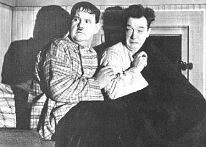
THE LAUREL-HARDY MURDER CASE (1930)

Laurel-Hardy Murder Case title card

RATING: *** out of ****

PLOT: Out of work and out of options, Stan Laurel and Oliver Hardy while away their time fishing at the dock. They can’t even catch fish right, of course! When Ollie notices the newspaper meant for fish-wrap contains a little classified ad summoning the “heirs” of the three million dollar Ebeneezer Laurel estate to the reading of the will, it appears the boys’ fortunes may soon change. Change they do… but not necessarily for the better. A spooky old mansion filled with eccentric help and even more eccentric relatives, the matter of the inheritance is sidetracked when it’s revealed that old man Ebeneezer was murdered! Now everyone’s on lockdown and Stan and Ollie aren’t sure what they’re afraid of most: the dark shadows, the bats flying through the house, ghostly bed sheets levitating over their heads… or their own shadows!

PREFACE: It’s not often that I precede a review with a special note, but I must do so in this case. This film was the favorite Laurel & Hardy film of my dear, departed friend Allen Schottenfeld. A member of the same “Sons of the Desert” tent to which I belong (for the uninitiated, the “Sons of the Desert” is the International Laurel & Hardy appreciation society), Allen often cited “The Laurel-Hardy Murder Case” as his favorite Stan and Ollie romp. In fact, he was videotaped at least once making that same declaration. Allen referred to this film as “a wonderful spoof,” and it is to Allen that the book version of “Scared Silly” will be dedicated.

REVIEW: Laurel & Hardy had only been a little over a year into their talkie careers when they decided to revisit the scare comedy antics they delivered in their silent classics, “Do Detectives Think” (1927) and “Habeas Corpus” (1928) As many of the boys’ films were at this time, “The Laurel-Hardy Murder Case” is a mix of brilliant comedy with some awkwardly-timed moments (the team hadn’t yet fully hit their stride in sound films, although they very shortly would).

It is telling that when Stan and Ollie have the screen to themselves (as in the first scene at the docks as well as some later scenes in the bedroom) they shine much more than those scenes they have to share with the supporting cast. Perhaps it was just that they were so comfortable with one another that they knew exactly how to play their bits of business and could certainly improvise their way through a scene. This was much harder to do when interacting with the supporting casts, having to read the lines straight so the others would know their cues.

This is also one of the first Laurel & Hardy films where Stan & Ollie had to interact with a number of other characters simultaneously, as opposed to a stock situation like the duo directly taking on one of their regular foils like James Finlayson, Billy Gilbert or Walter Long. A good example is the silent classic, “Big Business.” Once the tit-for-tat war begins between the team and Finlayson, the three are the sole focus. There are onlookers to the wanton destruction but they are not active participants. In “Murder Case” the scenario is a little more complex, and naturally so being a more precise mirror of then-recent films that would influence what would come to be known as being in the “Old Dark House” genre (including early film adaptations of Charlie Chan and Philo Vance detective stories as well as more blatant horror-comedy fare such as the original silent versions of “The Bat” and “The Cat & the Canary”). The film it resembles most though may be “The Old Dark House” – which is amazing in itself because “The Laurel-Hardy Murder Case” predates James Whales’ classic feature by two years! If a viewer didn’t know the release dates, they would swear the Laurel & Hardy short is a direct spoof of “The Old Dark House!” Instead, it merely paid good attention to those above-mentioned drawing room murder mystery stories that had been proliferating in both books and on the stage and slowly made their way into cinema. To spoof such material properly, screen time has to be given to the other characters in addition to Stan and Ollie. More often than not, these detours in “Murder Case” slow the film down.

Having said that, this short starts off with pure Laurel & Hardy magic, with a funny and charming scene at the dock. One of the great H.M. Walker title cards gets things started with “Mr. Laurel and Mr. Hardy decided that they needed a rest – they had been out of work since 1921.” The site of Ollie sleeping against a dock post while Stan gleefully fishes is enough to bring a smile to the face of any long-time Laurel & Hardy fans. Ollie’s rest is of course soon disturbed by Stan, who has placed the fish he just caught beside him, where it flails wildly beneath Ollie’s backside, waking him up! I’ve seen quite a few of their films with audiences, and they are two of the few performers I’ve witnessed get laughs simply by being on screen. Of course, it’s much more than that, since it’s the personalities that elicit the laughter. When Stan snags Ollie’s hat on the fish hook and sends it into the bay, Ollie is especially flustered (especially after getting a face full of water). Of course, these little bits of business also serve the purpose of setting the plot into motion. When Stan crumples up the newspaper he’s been using as fishwrap and tosses it out, the wind blows it right into Ollie’s face, where he reads the “legal notice” that “the heirs to the $3,000,000 estate of the late Ebeneezer Laurel” are being summoned to Laurel Mansion for the reading of the will (the classified ad is attributed to “L.A.H.” – .an in-joke evoking “Laurel and Hardy,” of course).

Using only Stan’s surname as his proof, Ollie ascertains that Stan must be one of the heirs. A hilarious early example of how the Stan and Ollie characters adapted to sound follows (you can read the dialogue below in the “Best Dialogue Exchanges” section). Ollie’s vocal intonations underscore his high opinion of himself. As Hardy (the actor) once explained, Hardy (the character) is “the dumbest kind of dumb guy there is… the dumb guy who thinks he’s smart!” Ollie’s voice indicates that he his pleased with himself and his (alleged) intellect in determining Stan is in line for an inheritance. Meanwhile, Stan’s speech patterns and dialogue are a combination of whimsical innocence, blank confusion and the occasional attempt to be bold. While hardly news to most of those reading this review, the duo’s ability to find “the perfect voices” for their characters not only made their transition to sound easier than the reigning silent comedians Chaplin, Keaton and Lloyd but actually enhanced their comedy. Consequently, their popularity was enhanced and they were catapulted into international superstardom. All the while, the duo held a reverence toward the physical comedy tricks they learned in the silents. They utilized sounds and dialogue as necessary but just as often their talkies contained stretches where no dialogue was spoken. The sound served to make their characters even more full-blooded than they already were, but was not the main component of what endeared them to the public.

After the whimsical opening bit we get down to horror business. An establishing shot of the mansion, standing forebodingly in the middle of a thunderously frightening rain and wind storm (of course) sets the tone. Inside the home, a cast of suspicious characters has gathered in all their Earl Derr Biggers-inspired drawing room glory, anxiously awaiting the reading of the will. They include an old man and woman, an ingĂ©nue, a dapper young man and a stern middle-aged fellow. Also on hand are a creepy old butler and a matronly maid who just seems a little bit “off.” Last but not least, a derby wearing detective and his men are on the scene. When the old woman asks what time the will is scheduled to be read, the detective answers, “sorry to disappoint you old dear, but there ain’t gonna’ be no reading of no will!” When further pressed as to why they’re all there if the will won’t be read, the detective proclaims, “You’re here because Ebeneezer Laurel didn’t die a natural death… HE WAS MURDERED!”

Fred Kelsey Laurel-Hardy Murder Case

The detective must be singled out here. In this short, Laurel & Hardy receive great support from the rest of the cast, but one performer in particular is a standout: Fred Kelsey. Kelsey’s role as the gruff detective on the case actually became an archetype. He would play the role again several times in both straight horror films (“The Invisible Ghost” with Bela Lugosi) and horror-comedies (The Three Stooges’ “If a Body Meets a Body,” a semi-remake of “The Laurel-Hardy Murder Case”). His character traits became so identified with a certain type of detective that soon others began imitating him and master animation director Tex Avery even did a direct spoof of Kelsey (in the classic cartoon, “Who Killed Who?” from 1943). His character was personified by wearing a suit complete with timepiece in pocket, a derby upon his head and two thumbs with which he often tugged at his lapels. Sometimes he chomped on a cigar; often he shouted out pronouncements of guilt with little or no facts to go by; always he had his bravura on display! In addition to his pronouncements, Kelsey had a way of pausing during his statements that was very comical. For example:

“Now get this, folks (PAUSE) I’ve got a hunch that Ebeneezer Laurel was murdered (PAUSE) By a relative (PAUSE) So that said relative (PAUSE) will come into all his dough!”

His visual flourishes matched his approach to dialogue. When a burst of wind blows through the window and knocks over a piece of furniture and a lamp. Kelsey does a wonderful, startled take and then locks the window shut. He also knew how to combine the verbal and visual to convey a “is that so?!” style – for example, when one dapper relative tries to leave the mansion citing “two theater tickets” the detective takes the tickets, rips them in half and asks his deputy to “show this gentleman to his seat!”

Making the trio a quartet is Frank Austin as the butler. Austin had a lengthy career doing character parts in films of all genres (playing in everything from “The Mystery of the Wax Museum” to “Mr. Deeds Goes to Town/Mr. Smith Goes to Washington,” as well as appearing alongside such other comedy legends as W.C. Fields, The Three Stooges and Olsen & Johnson. He popped up in several Laurel & Hardy shorts and features including an uncredited part in “Babes in Toyland” (aka “March of the Wooden Soldiers”) playing the justice of the peace who thinks he’s marrying Barnaby to Bo Peep (really Stan in disguise). His pliable face, cragged with a dour expression made him the perfect “mysterious” character whether being played straight-up or for laughs. He often played butlers, and in “Murder Case” he pulls out all the stops – a menacing laugh, a twisted facial expression and an ominous tone all combined to send shivers down Stan and Ollie’s spines… and sent moviegoers into fits of laughter!

When Stan and Ollie arrive at the mansion, they are no more above suspicion than the motley crew of Laurel relatives already gathered there. Told that they can’t leave, Ollie protests that the detective can’t possibly think he and Stan had anything to do with the murder. “I’m not saying,” the detective replies, “…but I believe that the criminal always returns to the scene of the crime,” he underscores. This is of course delivered in the stock blustery Fred Kelsey manner as described above, along with the imposing warning, “Don’t any of ‘ya try that escape stuff, ‘cause the house is surrounded!”

Before being beset by the detective, the butler and the scares that await them, Stan and Ollie show that they are their own worst enemies. The first sign of trouble is revealed in this exchange:

OLLIE: What a beautiful home, and what luxury! And to think, it’s all ours!
STAN: Whaddaya’ mean “ours” – it’s mine!
OLLIE: There you are – just like all the rest of them. Sitting on top of the world and turning down your best pal – your benefactor!

Ollie makes a pompous show of being dejected and feigns resignation, going through the motions as if to leave. His desired result is of course to guilt Stan into keeping the partnership intact and to make certain that Ollie “gets half of everything that’s coming” to Stan. Initially, it doesn’t work.

“Are you really going?,” asks Stan. When Ollie answers affirmatively Stan gives him his umbrella so he won’t get too wet on his way home!

The above theme of Stan & Ollie grieving over the possibility of splitting up because one or the other comes upon good (or bad) fortune would be a running gag not just throughout this short but also in other Laurel & Hardy shorts and features. For example, when released outside of America, the two-reel short “Laughing Gravy” was extended to three reels with the addition of a sequence that was almost exclusively about Stan coming into money and considering leaving Ollie behind. The bit comes off a bit more developed in “Laughing Gravy.”

Stan and Ollie are brought to a room where they are to spend the night. Everything in the room is covered by a sheet, and when Ollie asks the butler why, he gets the ominous response: “This is the room where the old man was murdered,” the butler sinisterly and gleefully reports. (Of course, astute viewers of classic comedy know the real reason for the sheets is to set up some ghostly gags later where the boys can mistake innocent inanimate objects for hostile spirits). To further unnerve our heroes, he points to the closet and dramatically adds, “His body was found in that cupboard!”

Stan and Ollie are visibly scared by the butler’s revelation, and it’s these little moments in all Laurel & Hardy films that show how special the team is. They don’t use dialogue, they’re not even using a wild take here, they are just showing that they’re scared using their facial expressions while at the same time staying completely in character. This ability to inhabit their characters 150%, to be fully immersed in “Stan” and “Ollie” is a trait that even some of their classic comedy peers of the ‘30s and ‘40s couldn’t match, And then, just as the butler has the boys where he wants them he delivers this killer coda: “Goodnight, gentlemen. I hope you have a nice, looooonnnngggg sleep,” he menacingly intones.

Well, they’re doing anything but sleeping as they encounter what are only the first of a series of scares they’ll face throughout the short. Typically, they begin by scaring each other. When Stan looks under the bed sheet, Ollie thinks it’s a ghost. When Ollie gets tangled in a bed sheet, he thinks a ghost is out to get him. Their self-scaring shenanigans are interrupted by a mysterious rapping…

A hand is seen on the edge of Stan and Ollie’s bedroom door creepily (and creakily) opening it from the outside. It is revealed to be that of the butler. He eerily asks, “Is everything all right?” The butler is simultaneously comical and creepy in the best horror-comedy tradition… and then becomes downright unnerving when he bares his long bottom row of teeth as if he’s half horse or donkey!

Laurel-Hardy Murder Case butler

More scares follow. Among them are unsettling scratching sounds, screeching black cats hiding in closets, their eyes glowing in the dark; and a painting of the Grim Reaper with a scary skull’s face, revealed when a sheet covering the canvas comes down. This last bit is pretty startling and effective; it’s easily the most unnerving image ever to appear in a Laurel & Hardy film.

After these initial scares, we are brought back to the running gag about Ollie wanting half of what Stan has coming to him. It seems Stan’s been so rattled he’s had a change of heart: instead of Ollie getting half of everything, Stan says he can have it all! It is one of those “comes the dawn” moments that the Stanley character occasionally has – here he knows full well that being a Laurel is not the safest thing to be at the moment!

There’s an interesting contrast in the use of the expression “dead men.” Ollie, trying to reassure Stan there’s nothing to fear says “dead man can’t hurt you.” The villains of the piece, justifying their decision to do away with Stan and Ollie (whom the butler refers to as “those shabby gentlemen”) reason that “dead men tell no tales.”

We are treated to an extended sequence of Stan and Ollie being scared witless. Many horror-comedy trappings are trotted out as well as a plethora of funny gags. They really are best experienced seen and heard rather than read about here, but I’ve done my best to sprinkle the details throughout the review and in the “Best Visual Gags” section. It is these delightful moments of Stan and Ollie in full-on terror mode that make this short a much-see and make up for its slow, dull patches.

Some real menace rears its head again when the butler tells the man with the theater tickets that he’s “wanted on the phone… downstairs in the library room.” We see the man enter the room, take a seat and lift the receiver and the… the lights go out and the man screams! When the detective runs into the room to check it out, the man is gone! This sends everyone into a panic, including the detective who can’t figure out what happened. Stan tells Ollie he’s going back home because he “can’t relax” but when he sees the others holed up in the hallway he gets scared (as do they) and all go running back into their rooms. Stan’s pounce back onto the bed (where Ollie is cowering under the covers) sends the mattress to the floor, leading to further hysterics!

The butler continues to send various guests down to the library room with similar results – a blackout, a scream, and then the disappearance of the guests. Ollie, in a moment of bravery says he’s “had enough of this” and declares that he’s “gonna’ find out what it’s all about!” Stan follows along and this leads to one of the short’s most hilarious moments, as Stan’s belt becomes entangled on the cord from a lamp obscured by a white sheet. Naturally, when he walks, the sheet-covered lamp follows his every move like a ghost! Ollie sees it and gets tangled with it, too. As Stan runs down stairs ensnared Ollie follows and the two come crashing to the bottom. It is an extended, hysterical sight gag as Stan is certain he’s either on the trail or being followed by ghosts!

Typically for a Laurel & Hardy short, the audience is only given a brief respite to catch their breath from all the laughter, as no sooner are Stan and Ollie sent back to their room than more craziness occurs. A bat flies into the bedroom and under the bed sheet. When Stan and Ollie get under the covers the sheet goes flying up like a ghost, levitating above them! Needless to say this sets off pandemonium as the boys once again run out of the room, into the hall and down the stairs. The detective and all his deputies run up the stairs to check out the commotion but when they see the sheet seemingly flying on its own, they run right back down the stairs again!

Laurel-Hardy Murder Case maid

The ending is one that fans have often debated. Or rather, the endings, plural. Stan and Ollie actually (accidentally) do something right for a change: investigating the desk and phone in the library room, they discover that the phone activates the trap door… but instead of Ollie being deposited wherever everyone else has been dumped the chair malfunctions and simply rises back up with Ollie in it. The duo are then besieged by the the maid, and during their tussle they rip off the maid’s wig, exposing the “she” as a “he.” But then… we dissolve into Stan and Ollie on their fishing pier, newspapers in hand, wrestling each other. It was all “just a dream!” Your ability to go with this is really dependent upon how you feel about dream endings in general. Fans of b-movie horror and horror-comedy films such as “The Corpse Vanishes” and “Sh! The Octopus” have bemoaned their “only a dream” endings as unimaginative copouts. Somehow, in the hands of Laurel & Hardy, it somehow feels okay, especially after the general wackiness that takes place for most of “Murder Case”’s running time. The duo would revisit the “dream ending” much less successfully in their later horror-comedy, “Oliver the 8th.”

This short is peppered with a lot of little touches that Laurel & Hardy fans love – Stan’s cry and whimsical way with words and concepts, Ollie’s blustery pronouncements (“why don’t you be careful!”) and heightened histrionics (“get the light… get the light!”) and in general, the duo’s ability to draw from a vast collection of facial expressions and body language to express everything from anger to fear, confusion to certainty (albeit often mistaken certainty) and so much more. It also features the first instance of Ollie uttering what would become one of his most-imitated trademarks, “well, here’s another nice mess you’ve gotten me into!” It provides an early showcase for comedienne Dorothy Granger who would go on to appear in several Laurel & Hardy shorts and also co-star with everyone from W.C. Fields to The Three Stooges to Leon Errol to Abbott & Costello (she also had a featured role in the Walter Catlett horror-comedy short, “One Quiet Night”). Fans can also enjoy erstwhile Chaplin and Laurel & Hardy foil Tiny Sanford in “Murder Case.”

With all of the above going for it, it is interesting then that many of those same fans as well as Laurel & Hardy historians generally have a lower opinion of this short. It is true that “The Laurel-Hardy Murder Case” isn’t flawless, but I have had opportunities to see it with a group and it has always played well in that setting. Considering that it was intended from the start to be seen with a group perhaps that is how it should be judged – on its ability to please an audience of more than one.

SPOTTED IN THE CAST – Lon Poff specialized in playing old men… for over 20 years! However, his full career in movies actually spanned 34 years, having started in silent. 1930’s old man role in “Murder Case” was one of his first septuagenarian gigs. He made his final appearance in 1951’s “Father’s Little Dividend”… playing an old man! Like famed comedian Andy Clyde, he ultimately, naturally grew into the role with little or no makeup required. Notable credits included such silent classics as “Dante’s Inferno” and “The Man Who Laughs” (with Conrad Veidt’s title performance cited as an influence on Bob Kane’s Batman-nemesis, The Joker) along with such sound-era fare as “Tom Sawyer,” “House of the Seven Gables,” “Sullivan’s Travels,” the “Flash Gordon” serial and “Joan of Arc.” On the comedy front he appeared with Laurel & Hardy previously in “Two Tars,” with Charley Chase in a trio of shorts including “Isn’t Life Terrible,” “Long Fliv the King” and “Calling All Doctors;” and with Wheeler & Woolsey in “Diplomaniacs” and “The Rainmakers.”

BEST DIALOGUE EXCHANGES:

By default the memorable piece of dialogue has to be the first use of “Well, here’s another nice mess you’ve gotten me into” but there are of course other gems here:

OLLIE: Where were you born?
STAN: I don’t know.
OLLIE: Fancy not knowing where you were born!
STAN: Well I was too young to remember!

OLLIE: Didn’t you once tell me that you had an uncle?
STAN: Sure I’ve got an uncle. Why?
OLLIE: Is he living?
STAN: No. He fell through a trap door and broke his neck.
OLLIE: Was he building a house?
STAN: No, they were hanging him!

STAN (after reading what the Laurel estate is worth): Three million dollars. Is that as much as a thousand?
OLLIE: Well man alive it’s twice as much!

(great dialogue underscores the Ollie character dynamic – as Hardy himself often explained, his character was “the dumbest kind of guy there is – the dumb guy who thinks he’s smart)!

DETECTIVE: Say you – where were you on the night of November the 15th?
STAN: The day before Christmas?
DETECTIVE: No, the day after Christmas! November the 15th!
STAN: November? (thinking out loud) Septober, Octember, Nowonder…

OLLIE: Well, here’s another nice mess you’ve gotten me into!
STAN: Whaddaya’ mean I got you into?
OLLIE: Well your name’s Laurel, isn’t it?
STAN: Well only on my mother’s side.

BEST VISUAL/VERBAL COMBO GAG:

DETECTIVE: Are you sure you’re a Laurel?
OLLIE (pointing to painting on wall): Why sure? Sure? Why, can’t you see the family resemblance?
DETECTIVE: Yeah, that happens to be General Grant!
OLLIE: Why of course it’s General Grant! His son and I belong to the same alma mater! Meaning Delpha Phi Delta. Rah rah rah, rah rah rah, sis boom rah!

BEST VISUAL GAGS:

Stan snags Ollie’s derby on the fishhook and sends it into the water. Pulling it back up, Ollie angrily snatches the hat from Stan and puts it back on his head… water and all!

Stan and Ollie arrive. Stan tries to close the umbrella but only opens it inside out!

Stan’s places his quivering hand on Ollie’s shoulder and Ollie gets frightened by it.

Stan accidentally drops a lit candle down the back of Ollie’s pajamas.

Stan lifts his nightshirt over his own head and gets stuck, flailing about in comical fashion.

BEST COMBO VERBAL/VISUAL GAGS:

DETECTIVE: Are you sure you’re a Laurel?

OLLIE (pointing to painting on wall): Why sure? Sure? Why, can’t you see the family resemblance?

DETECTIVE: Yeah, that happens to be General Grant!

OLLIE: Why of course it’s General Grant! His son and I belong to the same alma mater! Meaning Delpha Phi Delta. (Ollie does cheerleader style motions): Rah rah rah, rah rah rah, sis boom rah!

FURTHER READING: There are so many great Laurel & Hardy books out there that it’s a shame to pare down the list, but as far as “The Laurel-Hardy Murder Case” is concerned there are two that stand out. One is a handsome coffee table book simply called "Laurel & Hardy" by John McCabe and Richard W. Bann that I borrowed from my local library on nearly a continuous basis as a child. The book is loaded with both production and promotional stills from nearly all of Laurel & Hardy’s shorts and features, with a synopsis of each film and in some cases interesting background information. If more detailed background information is more your thing, then you’ll want to move directly to Randy Skretvedt’s essential, impeccably researched “Laurel & Hardy: the Magic Behind the Movies.” Both books have entries on “The Laurel-Hardy Murder Case,” as does this entry which was part of a fantastic overview of the majority of Laurel & Hardy’s horror-comedies from the Missing Link website.

BUY THE FILM: Well, after years and years of Laurel & Hardy fans pining for the best of the boys to be released on DVD, the wait is over! The “Essential Laurel & Hardy Collection” is just that, collecting the majority of the duo’s shorts and features that were produced at the hal Roach Studios, including “The Laurel-Hardy Murder Case.” You can order it when you click here.

If you still have a working VHS player you can get “The Laurel-Hardy Murder Case” and a few other classic Laurel & Hardy horror-comedies together in one videotape collection called THE LAUREL & HARDY SPOOKTACULAR. You can buy it here:


WATCH THE FILM: Since this is a short, there isn’t a trailer available but you can enjoy a brief sequence right here:

Friday, March 23, 2012

A FUNNY FRIGHT FOR FRIDAY

Van Beuren Tom & Jerry

Hello Scared Silly fans! I'm hard at work chipping away at my review of the short, "The Laurel-Hardy Murder Case" but still need additional time to complete it (hopefully I'll have it posted by next week).

In the meantime, I wanted to share some laughs from another of yesteryear's daffy duos, the animated comedy team, Tom & Jerry. NO - not the famous, Oscar® winning cat-and-mouse pair but an earlier team that frolicked across 1930s movie screens courtesy of the Van Beuren Studios (when the films were later released to TV and the 8mm home movie market in the 1950s the characters' names were changed to Dick & Larry to avoid confusion with the aforementioned feline-rodent twosome). Here's their public domain cartoon, "Magic Mummy."

HAPPY HAUNTING!

Wednesday, March 14, 2012

HORROR-ONABLE MENTION GOES TO…

Bowery Boys Up in Smoke

It’s been a while since I talked about my vision for the book version of “Scared Silly” (last discussed in this post).

For the uninitiated, I plan to divide the book up into chapters primarily based on either performers or “type” of film (for example, silent films and “series” films will get their own sections). Further, I may break the sections on performers up into “solo stars” and “comedy teams.” In any case, one thing I plan on doing with the performers is to not only do full reviews of their bona fide horror-comedy entries but also mention some of their “horror-onable mentions" (without providing full-fledged reviews of those films).

What’s an “horror-onable mention?” Well, it’s a film that either has only a peripheral horror/fantasy/sci-fi theme or one that contains a brief “scare scene” that is incongruous to the film as a whole. For example, there is a sequence in Laurel & Hardy’s “A Chump at Oxford” where the nasty college kids prank Stan and Ollie by scaring them half to death in ghostly skeleton outfits. The scene has the “scare” factor but it could just have easily been some other kind of scene without a scare element, another mean-spirited trick meant to embarrass Stan and Ollie. Not only is it incongruous to the film as a whole but it is brief as well. Therefore, “A Chump at Oxford” is an “horror-onable mention.” The same holds for the duo’s “Dirty Work.” Ostensibly one of the many Laurel & Hardy shorts to focus on how badly the team fared at manual labor (here as chimney sweeps), the short contains a sci-fi angle: the boys’ client is a kooky scientist trying to perfect his own “fountain of youth.” The final scene delivers the fantasy scenario but it is both too brief and devoid of any real scares to qualify as a full-fledged “horror-comedy.”

Stan Laurel Oliver Hardy

Speaking of daffy duos, Abbott & Costello have about as many if not more “horror-onable mentions” as they do actual horror-comedies. Consider such almost-but-not-quite horror-comedy entries as “Abbott & Costello Meet the Invisible Man” (it contains the sci-fi elements of making a man invisible without any scary aspects), “The Time of Their Lives” (Lou Costello is a ghost, but a friendly one), “Abbott & Costello Go to Mars” (they don’t – they go to Venus and it’s filled with beautiful women, not scary monsters) and “Comin’ ‘Round the Mountain” (for its very brief scene of Margaret Hamilton as a witch). “Keep ‘em Flying” is on the “horror-onable mention” list, too for its spooky amusement park funhouse scene – it is too brief and incongruous to the film to be considered a bona fide “horror-comedy” entry.

Abbott & Costello Go to Mars

While responsible for one of the most unique “horror-comedy” entries of all (“Ghost Catchers”), Olsen & Johnson have a couple “horror-onable mentions” under their belt as well. “All Over Town” flirts with a very brief moment of mild scare humor as the team perform on an echo-ey stage in an old, creaky theater. Even more explicitly (and even more briefly), the frantic free-for-all “Hellzapoppin’” surprises audiences with a quick cameo from Universal’s most famed horror icon, the Frankenstein Monster! One wonders, did moviegoers cheer when the creature tossed Martha Raye through the air? Or did they cower in their seats and shiver with fear? Either way, “Hellzapoppin’” is not a horror-comedy, so this scene rates it an “horror-onable mention” at best.

Hellzapoppin' Frankenstein's Monster

…and on it goes. It seems the more horror-comedies a performer or team had (the Bowery Boys are another great example, with such horror-comedy classics as “Master Minds,” “Ghost Chasers” and “The Bowery Boys Meet the Monsters”), the more “horror-onable mentions” they had as well (“Bowery to Bagdad,” “Mr. Hex” and “Up in Smoke” all fall into this category for Leo Gorcey, Huntz Hall and the boys). Really, we could do this all week but I think you get the idea.

I’ll close with another team – the Ritz Brothers – that has one bona fide horror-comedy (“The Gorilla”) and a couple of films that get “horror-onable mention.” The Sonja Henie/Adolphe Menjou vehicle “One in a Million” features the brothers doing a comedic song-and-dance number (on ice skates!) portraying the villainous Peter Lorre, Captain Bligh (a spoof of Charles Laughton’s performance in “Mutiny on the Bounty”) and once again, the Frankenstein Monster! Now, it seems the Frankenstein Monster was rubbing elbows with a lot of comedians before he met Bud and Lou (read my post about how he also met Danny Kaye, Buster Keaton and the Three Stooges by clicking here). But that’s not all...

...in “Sing, Baby Sing” the brothers do a skit spoofing Dr.Jekyll and Mr. Hyde that ends with an appearance by… you guessed it... the Frankenstein Monster! Unlike other spoof versions that satirized or plain old used Boris Karloff or Glenn Strange to portray the monster, this version of the monster bears a more striking resemblance (including vocal inflections and presence) to the one played by Peter Boyle forty-something years later in Mel Brooks’ “Young Frankenstein” – and it’s no surprise, as Brooks has often cited the Brothers Ritz as one of his major influences. Click here and decide for yourself!

Wednesday, March 7, 2012

MY FIRST PERSONAL APPEARANCE OF 2012

Paul Castiglia Chris Allan

Hello, fans. Just a quick post to let you know about my first personal appearance of the year. Pop on over to the Clifton Comic Book Expo (admission is FREE!) on Sunday, March 11th from 10 to 4 at the Clifton Recreation Center, 1232 Main Street in Clifton, New Jersy.

I'll be there along with my good friend and artist supreme, Fernando Ruiz. Fernando was the artist on the “Archie’s Weird Mysteries” comic series I wrote and we’ll be signing copies of the paperback collection of that kooky, spooky horror-comedy while supplies last.

Photobucket

I’ll also have copies of the Midnight Marquee Actor Series Vincent Price book to which I contributed. I have an even more limited supply of those, so if you’re in the area and want to get a copy be sure to drop by. It contains my essay on Price’s trio of horror-comedies with Peter Lorre including such classics as “The Raven” and “The Comedy of Terrors.”

Midnight Marquee Actors Series Vincent Price

There will also be plenty of comics for sale from all decades to purchase from a variety of vendors. I might even bring a random sampling of some of the other comics I’ve written through the years, including those starring the Teenage Mutant Ninja Turtles and Superman’s Pal Bibbo. I’d love to meet you so please stop on by.

Now here’s an encore presentation of my television appearance from this past summer on the show, “Comic Book Conversations” hosted by Scott Golodner and co-starring David Levin. Enjoy!

Wednesday, February 29, 2012

TO HEIR IS HUMAN (1944)

To Heir is Human Harry Langdon Una Merkel

RATING: ** & ½ out of ****

PLOT: Mistaken for a private detective, Una Merkel decides to play along with the charade for the chance to earn a thousand dollars. Her task: find missing heir Harry Langdon within 24 hours. She just doesn’t realize that she’s been hired by one of Harry’s greedy relatives (Lew Kelly), head of a dastardly trio (including Christine McIntyre and Eddie Gribbon) out to do away with Harry so they can be next in line for his inheritance! Can Una and Harry turn the Grim Reaper into a Grinning Reaper and literally survive a night in a spooky house?!

REVIEW: As mentioned in other “Scared Silly” reviews, the Columbia shorts department was constantly trying to hit pay dirt with a comedy duo to rival Laurel & Hardy and Abbott & Costello’s popularity. Some inspired teams came from these attempts – namely (Wally) Vernon and (Eddie) Quillan, (Gus) Schilling and (Dick) Lane and Hugh Herbert and Dudley Dickerson (although that last team was never billed as such – Herbert received top billing).

For this short, Columbia tried pairing vivacious comedienne Una Merkel with Harry Langdon, whose fame as well as box office receipts briefly (about three films briefly) rivaled Chaplin’s, Keaton’s and Lloyd’s in the silent era, and whose merits have been debated ever since (Langdon has many champions and I count myself among them. He also has many detractors). Merkel, the once stand-in for Lilian Gish began as a dramatic actress in silents and appeared in the early-talkie and horror-comedy template “The Bat Whispers” but her funny side (she fell somewhere between Helen Kane and Gracie Allen, but more subdued than either) really flourished in several late 1930s/early 1940s shorts and features (most notably the W.C Fields classic, “The Bank Dick”).

For Una, this was her second and final short for the Columbia unit and her second teaming (she previously appeared in tandem with Gwen Kenyon). For Langdon, this was Columbia short number 17 and not his first as a member of a team (previous teammates included Monty Collins and Elsie Ames); after “Heir” he’d finish up with four more Columbia shorts, teamed-up with but practically playing second banana to Swedish dialect comic, El Brendel. Both Merkel and Langdon had prior horror-comedy experience: she as part of an all-star cast in the pseudo-comedy-horror “Cracked Nuts;” he in a few shorts including “Goodness, a Ghost!” for RKO and another Columbia, “Shivers.”

Interestingly, this particular short received a bigger budget and longer running time than other Columbia shorts, which typically ran between 16 and 18 minutes (this one ran a full 20 minutes). One of the most noticeable differences is that once it hits the second reel, the short has its own score. Although the Columbia comedy shorts were spun off from the “Musical Novelties.” series of shorts, after the Three Stooges’ sing-songy “Woman Haters” hit with audiences the studio recognized it was the gags and jokes that kept audiences coming back for more. They decided it was best to dial down the music in favor of the laughs. In any event, no one has uncovered a reason why this particular short was singled out for special treatment. Maybe Columbia just took notice of the hefty box office receipts brought in by that early ‘40s pair of boy-girl horror-comedies, “The Ghost Breakers” (Bob Hope and Paulette Goddard) and “Whistling in the Dark” (Red Skeleton and Ann Rutherford) and thought they had a launch-pad here for similar success. The music during “Heir’s” scary sequences sure is reminiscent of the feature length horror-comedies of the day.

While Una and Harry are billed as a co-starring team, Una’s name comes first – the result of a simple “ladies first” courtesy, perhaps? Or maybe just the fact that Una’s antics dominate at least the first half of its running time.

The short starts off on uneven footing by putting Una through some slapstick paces. She is distributing new phone books and retrieving those that are out of date. She is bodily thrown out of one office whose owner chides her for “soliciting” and then a phone book is tossed into the hallway right into her posterior. With precision trajectory the flying directory sends Una sailing into the office across the way, which just so happens to be the “Hide & Seek Missing Persons Buereau.” This sets up the plot proper, but unfortunately it doesn’t signal an end to Una’s physical trials.

As Una tries to get her bearings, a man hands her a business card that reads, “A Raven Sparrow, Coo Coo Manor.” He also attempts to secure her services as a private detective. Her protests to the contrary are silenced when the man gives Una a photo of Harry Langdon and offers her one thousand dollars if she finds the “missing heir.” After all, Una muses, “If I had a thousand dollars I could get a permanent wave!”

She doesn’t have to look far for Harry – he’s right outside the window, being that he’s a window cleaner. And so we’re back into the slapstick with little rhyme or reason. Harry Langdon once said of his Columbia assignments that “When I play in what I call the O-Ouch-O comedies, where the comedian runs about, is hit on the head, etc., I am just an animated suit of clothes.” Sadly, in this instance it is Una doing most of the running about and being hit, acting as an animated dress if you will. In her attempts to get Harry to come along with her Una is repeatedly stuck in a window pane, nearly (accidentally) drilled by a dentist, knocked to the ground and knocked about in general. It’s all a bit jarring. It’s Una’s bubbly and unflappable personality that gets the viewers through these scenes, like a puppy or kitten that continues to wag its tail no matter how much roughhousing they’ve endured at the paws of the older, larger household pet.

Ultimately this chase sequence draws to a close, helped along by its final setting, which has Una and Harry interrupting a corporation’s big business meeting. They frantically chase one another around but pause long enough for Harry to insert an inspirational speech of his own: “Gentlemen, I propose that we get bigger and better businesses – our customer doors are…” and it trails off into something both unintelligible and nonsensical. Somehow it all ends with Harry sliding chest-first across the boardroom table, papers flying everywhere!

To Heir is Human promo shot

The trio of villains is introduced next, in a fun little sequence that matches the usual horror-comedy formula for scheming villains to a tee. When Una calls A. Raven Sparrow to inform him she’s found Harry, the ringleader informs the others (and the audience) that Harry stands to inherit a fortune if he survives the night… unless he meets an untimely, “accidental” end. Each gets to extol his or her own brand of villainy as being the most effective for the job at hand. Slinky, sexy Velma plans to play the kissing cousin and slip Harry a Mickey. Brutish Bobo wants to use physical violence. But Raven has devised a more “shocking” exit for Harry – literally – with a bed rigged to deliver 100,000 volts of electricity to whoever uses it! Each relative is the perfectly played archetype. Christine McIntyre as Velma essays her classic vampy femme fatale.. Eddie Gribbon as Bobo is as bulky and punch-drunk as Maxie Rosenbloom ever was. Tall, pallid Lew Kelly as Raven is a cross between Boris Karloff and Raymond Massey, and affects the stock diabolical laugh used by countless creepy villains in both animated cartoons and live action productions of the 1930s, ‘40s and ‘50s.

As we move firmly into the second reel portion, Una and Harry approach the house and the spooky background music begins. Unbeknownst to the innocent pair, Bobo has climbed a tree over the garden bench. Every time Una and Harry look away, Bobo throws a rope down to remove objects like tree stumps, Una’s hat (which Bobo both removes and replaces) and a lantern. At first both are scared, but Una abruptly switches gears and brushes it off, insisting they get into the house (perhaps she remembered the thousand dollars and permanent wave).

Harry next gets to do some visual character bits which add weight to the argument that his talent was immense if often (self)misguided. First he crouches down and slips into the house through the bottom half of the door. He does so with such grace and finesse while at the same time in a comical way that his silent film training appears on full display. All the more impressive when you realize how quickly the bit comes and goes. Next comes the most impressively composed shot of the short, as Harry in extreme close-up lights a match to guide his way. Again, all the acting is as if he’s back in a silent, his malleable face telling the audience volumes about his fear. When Velma flips the light switch and Harry sees her seductively lounging in an arm chair, Harry’s version of a double-take response is to leap backwards away from her! As Velma approaches Harry he keeps fluttering backwards, removing his hat while trembling and stuttering. The scene is capped by Harry accidentally spilling the acidic liquid meant to be his demise.

By contrast, Una’s next scene falters by requiring her to do visual comedy. Una was funny – she made goofy faces, had comical body language, and was the perfect combination of quirky and clueless. It was her persona from which her humor derived. By forcing her into stock slapstick and sight gags that depended more upon situation than personality, a little was lost in the translation. Una climbs a trellis to try to enter the house. It teeters and tilts toward Bobo, who almost snatches Una several times. She’s back on firm footing – literally and figuratively – when she enters the home through a bedroom window, wondering aloud where Raven is with her thousand dollars and hiding behind the door in fear when Bobo tells Raven she’s in the house. As the villains exit the room, Una collapses to the ground in typical Merkel fashion.

The climax plays out with a parade of fright gags as is so common to the second reel of horror-comedy shorts (though in this one, the gags are none too scary). Most have a visual touch. We get a frantic hallway scene with characters running in and out of doors and often converging despite their opposition (similar to the scene in Buster Keaton’s horror-comedy silent, “The Haunted House”… and much later parodied to death on the late ‘60s “Scooby Doo” cartoon show). Harry is truly an animated suit in these scenes but in this context, it’s a very funny suit indeed as Langdon extends his arms, legs and facial muscles in kooky contortions. This funny bit is marred by another Una slapstick setpiece as she’s knocked out, placed on the electric bed and shot through the air by its voltage. Harry’s attempts to “get help” put him in the villains’ paths, particularly Velma who sets Harry into a tizzy with a tantalizing liplock. Again, the array of hysterical facial expressions pulled off by Harry in this second reel more than make up for his more inert performance in the first reel.

True to form, you have to take the good with the bad in “To Heir is Human.” After some nice reaction comedy from Harry, a very dark gag ensues: roped from above by Bobo, a noose is knotted around Harry’s neck and as Bobo pulls Harry up, he clutches at the rope while making distorted faces. Depending upon your tolerance for black humor, this particular gag may be too much or just right. I personally find it a little too close to reality to laugh at it. Thankfully the off-putting mood is shattered… and so is a statue, right on top of the villain’s heads and Harry wrangles out of the rope to rout the bad guys! The short would have done well to fade out right there, but one last bit is squeezed into the proceedings. Unfortunately, it’s spectacularly unfunny: as Una and Harry run off the property, Bobo once again lassos them. Their fear is so great they pull Bobo (obviously a stuffed dummy) from the tree and drag him behind them. The End.

Like so many efforts in the horror-comedy genre, particularly horror-comedy shorts, the good work of the players is simply undone by other elements. Here it’s the direction and production. Director Harold Godsoe was a second unit or assistant director on nearly 20 films, but only a full-fledged director twice: on “To Heir is Human” as well as an Italian-American film featuring more Italian than English. By this point Langdon’s career was considered to be in sad decline and his El Brendel team-ups to come lack the fire of his early efforts. But something about “Heir” livened Langdon up. While rather subdued and even lackluster in the short’s first few scenes, Langdon’s vigor returns with a vengeance for the scare scenes, resulting in one great take after another (for example, the faces he makes when he catches a whiff of the poisoned drink he’s been served are priceless). Likewise, Una’s energy and cute, perky-quirky qualities carry along the majority of her scenes with appealing whimsicality. The supporting cast is game, with the villains in particular adding zest to the proceedings. Unfortunately the flat direction, awkward pacing and weak compositions and too many knockabout gags at the expense of Una are a bit unnerving (it's difficult seeing a woman thrown and bashed about - the comedy factor is diminished to practically non-existent as opposed to when some goofy male schlub is on the receiving end). Last but certainly not least, for a horror-comedy this one is devoid of traditional scare scenes and trappings - sure, it's got the spooky house bit down but one wishes to see a skeleton dangling, giant cobwebs or the villains wearing ghostly sheets. All these factors combine to lessen the impact. It’s an average film at best, elevated to slightly above average status due to its performers and their performances.

SPOTTED IN THE CAST: Heine Conklin plays the dentist. A member of the famed Keystone Kops from the silent comedy era, Conklin had a long career spanning over 400 films and appeared alongside such legendary movie clowns as Charlie Chaplin, W.C. Fields, Mae West, Wheeler & Woolsey, Hugh Herbert, The Three Stooges, Olsen & Johnson, Andy Clyde and Abbott & Costello (including a role in “Abbott & Costello Meet the Keystone Kops,” of course). He turned up in series films like the Blondie, Charlie Chan and Lone Wolf films, the Green Hornet serial and classics ranging from Marilyn Monroe’s romantic comedy “Monkey Business” to Richard Widmark’s film nor “Pickup on South Street” to the Lon Chaney biopic, “Man of a Thousand Faces.”

BEST DIALOGUE EXCHANGES:

UNA: You’re the missing heir to a fortune – you’ve gotta’ come with me!

HARRY: A fortune?! I don’t want a fortune – I can’t afford one of those things.

UNA (frustrated that Harry has run off): He’s not going to get away with my permanent!

HARRY: (pointing to the smoking floor after accidentally pouring corrosive acid on it): Lady, your floor's got a hot foot!

BEST GAGS:

When Una realizes the man she’s looking for is right outside the window, she rushes at Harry, but Harry comes through the next window. They then confer about who Una is seeking, until Una realizes she’s talking to him.

As Raven sits down on the bed to explain how the electric booby trap works, Bobo pulls the switch, sending watts and volts through Raven and catapulting him through the air!

Unnerved by the frightening atmosphere at the house, Harry doesn’t realize he’s clinging to (and slightly raising) Una’s hemline.

When Harry raises his poisoned glass to toast his fortune, he knocks it into a statuette, which punctures the glass so the corrosive liquid leaks to the floor, setting it on fire.

As Harry pours another poisoned drink into a plant vase, the plant goes through its death throes, playing out a death scene worthy of a hack actor.

BEST COMBO VERBAL/VISUAL GAG:

UNA (running down the stairs): Where are you going?

HARRY (running up the stairs): I’m going upstairs to get you!

FURTHER READING: Ted Okuda and Edward Watz wrote an indispensible book called “The Columbia Comedy Shorts” and Leonard Maltin wrote one called “The Great Movie Shorts” (also known as “Selected Short Subjects”). You can order them here:

Selected Short Subjects: From Spanky to the Three Stooges (Da Capo Paperback)


I also encourage you to visit The Columbia Shorts Department – Greg Hilbrich’s excellent site dedicated to the fun and frolics of this studio that gave the world The Three Stooges and so much more.

To Heir is Human still

Monday, February 20, 2012

THE GHOST BREAKERS (1940)

Ghost Breakers poster

RATING: *** & ½ out of ****

PLOT: When Mary Carter (Paulette Goddard) inherits a castle on a Cuban island, her attempts to claim the inheritance are met with death threats and scares. Tales of ghosts and zombies are meant to frighten and deter her, both before she leaves for Cuba and after she gets there. Meanwhile, radio announcer Larry Lawrence (Bob Hope), a muckraker whose favorite targets are local racketeers opens his mouth a little too wide during a broadcast and now the thugs are after him! A mix-up with a trunk lands Larry literally on the same boat as Mary… and figuratively in the same boat in terms of the terrifying trouble that lies ahead! The pair, accompanied by erstwhile valet and assistant Alex (Willie Best) explore the castle grounds and do indeed come face-to-face with ghosts, zombies and a murderously spooky plot to keep the castle and its treasures out of Mary’s hands!

REVIEW: “The Ghost Breakers” represents a watershed moment in the history of horror-comedies. While its legitimately scary zombie has an antecedent in the sea hag from Hugh Herbert-Allen Jenkins’ “Sh! The Octopus” it ups the scare ante considerably and kicks off the 1940s with a template that would go on to serve many of the funny fright flicks to follow, whether sporting legitimate terrors (most notably Brown & Carney’s “Zombies on Broadway” and the all-time classic, “Abbott & Costello Meet Frankenstein”) or trumped-up terrors (like the Kay Kyser starrer “You’ll Find Out” which followed five months later or Abbott & Costello’s “Hold That Ghost,” which appeared a year later). Specifically, it sets the tone for 1940s horror-comedies and even comedies in general to one where flippant heroes can be both brash and insulting in the face of terror regardless of whether they are being scared out of their wits (a sharp contrast from the 1930s’ genteel Laurel & Hardy fright reactions or the absurdist machinations of a team like Wheeler & Woolsey).

In addition to the ramped-up scare quotient, the amount of verbal barbs and one-liners has also noticeably increased over 1930s’ efforts. Despite a lengthy detour or two, it has one of the best scripts ever conceived for a horror-comedy, spookily effective direction from George Marshall, a resourceful and compelling heroine in Paulette Goddard, a truly horrific zombie monster portrayed by Noble Johnson and superlative clowning and jokes from comedy legends Bob Hope and Willie Best. All this plus a top-notch supporting cast full of surprises like an early featured part for Anthony Quinn and Jack Norton in a brief bit doing what he did best – playing the befuddled drunk.

The film hits the ground running with a thunderstorm raging through New York City. In the hotel room of Paulette Goddard and her suave companion, the lights have gone out. When Paulette calls to room service to report the trouble, she learns that the whole building’s electricity has gone down in the storm. This helps clue in the audience to the plot immediately, as Paulette asks the front desk to send up some candles so she can see what she’s doing while packing for her trip to Cuba. When her companion, Mr. Havez of the Cuban consulate (there to witness the transfer of Paulette’s great-great grandfather’s castle to her) notes that the lights have seemed to go out throughout the whole city, the crack screenplay provides an immediate insight into Paulette’s character: as lightning races across the sky outside her window and thunder roars bombastically, an expression of total adrenaline and satisfaction lights up her face. “Exciting, isn’t it?” she declares. Paulette will be a reluctant damsel in distress at best, and the perfect counterpoint to Bob Hope’s patented coward, who’s more apt to be out to save his own skin when faced with trouble.

The first portion of the screenplay accomplishes what the script for “Abbott & Costello Meet Frankenstein” would eight years later: it deftly sets up a backstory with an economy of footage by making the reveal of that backstory an organic part of the exposition. Within the first several minutes we learn Paulette Goddard’s character Mary is heir to an ancestral estate on an island just off of Cuba (ominously named “Black Island”). We also learn that the castle on the estate is rumored to be haunted by the ghosts of Mary’s ancestors. There are several parties interested in the transaction – among them are the aforementioned Mr. Havez from the Cuban consulate, and Mr. Parada who delivers the deed to Mary but is hoping she’ll just sell the property to him. Last but not least is a mysterious telephone caller (played by Anthony Quinn in an early role) who warns Mary of the danger ahead. And just as the “Meet Frankenstein” script provides incidents that would naturally culminate in the main characters coming together, so too does “The Ghost Breakers” screenplay deliver a reason for Bob Hope’s path to cross Paulette’s.

(NOTE: To make this review easier to follow, from here on out I’ll be mentioning Bob Hope, Paulette Goddard and Willie Best by their real names instead of their character names.)

Unfortunately, after this great opening the script gets bogged down a little in its details. It’s entertaining enough in the unfolding, but you do wish the film would get to its next batch of scary bits quicker than it does. This demerit coupled with a few unfortunately stereotypical barbs at the expense of African-American performer Best keeps me from giving the film a full four stars, but it’s still a classic. The blame really belongs to the two subplots of shady characters trying to manipulate Paulette into selling her inheritance and a murder involving the aforementioned racketeers (or is it) that Hope manages to accidentally witness. How does this all tie together? Goddard just happens to live (or is at least staying) in the same upscale hotel that serves as the racketeers’ headquarters.

Some background: a common phenomenon of the 1930s and ‘40s was the “muckraking radio reporter” that routinely dished dirt about local mobsters over the airwaves. How did they get the dirt? There was usually a disgruntled lackey somewhere within “the organization” willing to spill the beans for a price. Most of the time the egomaniacal mobsters didn’t care about the gossip as long as it made them sound good… or at least tough and in control of their rackets. Basically, all a reporter had to do to preserve his life was not rub the thugs the wrong way – which meant that they pretty much had to deliver whatever the goons handed to them, report it straight, do no editorializing, don’t get the story wrong and above all else, don’t insult the gangsters! This last actually serves as the plot catalyst for another classic horror-comedy, Brown & Carney’s “Zombies on Broadway.” In “Ghost Breakers,” Hope unwittingly breaks all those rules by relaying a spurious tip from “Raspy Kelly” about notorious crime lord “Frenchy” Duval. When Hope asks Kelly if his mob knows he’s feeding these stories, Kelly just brushes off the question. After Hope’s latest dish on Duval, the maligned mug requests a meeting with Hope, promising to “give it to him straight.” Its while on his way to confer with the disgruntled hood that Hope realizes the real danger he’s in.

The screenplay serves a dual purpose: in addition to telling a compelling tale where the audience can root for the heroes to overcome the obstacles before them, it also both capitalizes on and adds to the Bob Hope persona. Hope was already a hit on the vaudeville and Broadway stages as well as on radio, and had dabbled in movies, most notably short subjects and a few features before his breakout role in 1939’s “The Cat and the Canary.” It was based on the 1922 play of the same name, discussed previously here as a horror-comedy template. Following just a year after “Cat,” “The Ghost Breakers” has the feel of an unofficial sequel to the earlier film – sharing both Hope and Goddard as its leads and like its predecessor, its feet firmly planted in classic horror-comedy territory. Hope’s character – full of bravura one moment and scared witless the next – was key. In later years instances of “self-preservation” would be added to the mix making the character a comedy relation to Daffy Duck, Basil Fawlty and George Costanza. And yet Hope was much more endearing than any of the above.

So the script gives the Hope character a chance to gain further momentum and build familiarity with audiences at every turn. For example, Bob mentions that every time there’s a storm something happens to him – “You remember that Greek girl in Los Angeles” and “that dame in Cincinatti” and “the redhead in Poughkeepsie.” It would become a Hope hallmark to be self-deprecating and yet also cast his own character in a spurious light. Hope also questions the radio station’s decision to run on auxiliary power during the blackout so he can do his broadcast. “Did they get an okay from heaven,” he sarcastically asks Best, pointing out another facet of the Hope movie character – a bit weary of authority, but in a more general (and genteel) sense than a rebellious misanthrope character like the one often played by W.C. Fields or an anarchic iconoclast like Groucho Marx. While Hope wouldn’t go beyond the occasional snarky comment, anything else would require too much work, especially starting a revolution.

It doesn’t make much sense that Hope goes to Frenchy’s hotel after getting such a threatening phone call from the hood, but it does help move the plot along. An effectively suspenseful scene follows where the lights flicker on and off due to the storm, Bob ducks into a room, guns go off (including Hope’s) and a man is shot dead in the hallway. If you stumbled upon this scene on a late night TV broadcast of the film, you might wonder, “what is Bob Hope doing in a gangster movie?!” Yes, multiple guns are fired and in the excitement, Bob’s gun goes off, too leading him to believe he just killed one of Frenchy Duval’s men. He ducks into Paulette’s room, where they exchange a barrage of snappy banter loaded with Hope’s one-liners and deprecating comments. When the police come to search the room, Hope hides in Paulette’s trunk… conveniently landing him on the same boat to Cuba as Paulette!

There’s one complication: the dead man is identified as Ramon Mederos – the same man who telephoned Paulette to warn her of imminent danger! Played by Anthony Quinn, and possessing a secret that will keep him in play throughout the rest of the film, Mederos in many ways foreshadows the Larry Talbot Wolf Man character as portrayed by Lon Chaney, Jr. in “Abbott & Costello Meet Frankenstein.” The two actors have similar features and they carry their characters in similar ways – they are earnest yet foreboding.

Bob Hope Willie Best Ghost Breakers

Willie Best is fantastic in the film. While he’s in the “servant” role he carries himself with such assurance that it’s easy to forget the standing of his character. The scene where Best goes to the ship’s cargo hold to find the trunk that Hope is hiding in is a showcase for Best’s visual and verbal talents. His body language and facial expressions as he approaches each trunk coupled with some muttered asides are funny indeed. He even starts singing a song about his missing boss, “Oh Mr. Larry was a…” When he comes face-to-face with a cop the script (or maybe it’s an ad lib?) affords Best’s character a sublime moment to kid the stereotyped roles he and fellow comics Mantan Moreland and Dudley Dickerson often found themselves in: “I just love to fool around with baggage – I used to be a porter! I been around trunks for 20 years now…”

The scene only gets better as one of the silver screen’s most prolific “perennial drunks” come along to find Best talking to the trunk. Naturally Norton pegs Best as a master ventriloquist! In an hysterical drunken drawl, Norton keeps verbally expressing his amazement with lines like, “It’s marvelous! I never saw your lips move one bit! I’m going to stand right here until you do it again! C’mon, do it again! Best, already beyond nervous over Hope’s situation bellows, “Mister, I ain’t always got the power!” Despite Best’s denials Hope’s cries of “get me out of here” leave Norton convinced Best is continuously doing the bit. Norton insists that Best and the trunk come back to the mainland with him so he can “pass the hat” and “make a fortune” on the “act!”

More plot complications ensue – it seems all involved (and the two that wished they weren’t – Hope and Best) end up on this boat to Cuba. Hope is ultimately extricated from the trunk but must go back to hiding in it when Mr. Parada comes into the stateroom asking Paulette who made a call to her. Meanwhile, a note is delivered to her reading, “Death waits for you on Black Isand.” Paulette tells Parada that Ramon Maderos was the one who called. Parada asks if Maderos mentioned him and then reveals that he’s also sailing to Black Island. Paulette spirits Parada away so he won’t discover Hope, Bob discovers the threatening note that was delivered to her. Citing the fact that Paulette saved his own life, Hope vows to help her out, with Best’s help. Not without trepidation, however: when Best asks Hope if he’s scared, Bob replies, “I’m shakin’ so hard, the water on my knee just splashed!”

Out on the deck, Parada continues to try to dissuade Paulette from taking possession of the castle. His dialogue is full of ominous foreshadow. “It may be some time before you see New York again,” he says. He also mentions that “There’s a great deal of fog on Black Island. At times it completely shrouds the castle.” Paulette remains tough and determined: “You can’t discourage me. I’m going to have fun in Cuba.” Parada presses her that there are things the travel brochures don’t show… like ghosts and zombies! “I was a skeptic too until I saw with my own eyes this malignant force at work in your castle.” He weaves a tale that Paulette’s ancestor who built the castle was a slave trader and how it’s besieged by all the lost souls of those “tortured, starved and murdered” in the castle dungeon, now out for revenge.

Meanwhile, Hope has wandered on deck. “Pardon me – am I protruding?” Hope, having overheard the discussion about ghosts barges in on the conversation and introduces himself to Parada as being a “ghost breaker.” He explains that he takes “family skeletons” out of the closet to “dust them off.” He goes on to state that he “explain(s) mysteries that people don’t want explained.” It’s an interesting move for the otherwise cowardly Hope – some bravado to rattle Parada. And really not far from the truth when you consider what his job as a muckraking radio reporter entails!

Hope’s bluff works well, as Parada lets out some key information that he “believes” the castle is haunted by just one ghost, the spirit of Don Santiago. “Does he appear nightly, or just Sundays and holidays,” Hope quips.

Bob is committed to seeing the situation through, and as the intrepid trio review the facts, Bob makes an interesting observation about Parada – that he looks guilty but “in situations like these you never suspect the guy that looks guilty.” He also makes note that all the interested parties have some sort of angle… and it hasn’t gone well for most of them. Hope goes through the list: “First Mederos – somebody found out he was about to tell you something important – exit Mederos” and continues until he gets to his own troubles).

More intrigue ensues on the ship – everyone seems to be vying for Paulette’s attentions, and not all in a good way. When Paulette returns to her room there’s a knife pinned to the door – on the inside – with something fuzzy hanging from it. A little man is seen on the other side of the door listening, and he’s stopped by a man named Geoff Montgomery, who is introduced during this scene. Apparently Geoff and Paulette know each other from a “six day bike race.” He identifies the ominous object hanging from the door as a “voodoo ou-anga”. He explains that they’re prepared by voodoo priests and often bring good luck, but this particular one is a “death ou-anga."

Meanwhile Bob uses more psychology on Parada, telling him he plans to go to the castle before Mary does, and that he’ll be so scared that if he sees any “ghosts” he’s liable to take a shot at one. He ditches dinner with Paulette and Montgomery, who underscores that many mysterious things happen on the island. Paulette gets a taste when she spots what looks like Ramon Mederos. She wonders aloud if he’s a ghost. The man approaches her and reveals that he’s Francisco Mederos – Ramon’s twin brother. He presses her to tell him who killed Ramon and why.

There are other little details and small talk amongst characters but once that passes we finally get to the “meat” of the film: Hope and Best row their way to Black Island. No sooner do they dock than they encounter a zombie. A particularly horrific one at that – among the scarier creatures to appear in a horror-comedy and about the most startling monster since the sea hag-witch in “Sh! The Octopus.” The housekeeper (credited as “Mother Zombie”) shoos them away but that doesn’t stop the duo from approaching the castle entrance to investigate further.

It’s in the castle that “The Ghost Breakers” pulls out all the stops. There are so many spooky and scary touches that if the ample jokes didn’t already ensure this film’s placement in the horror-comedy hall of fame the effectively creepy bits would. Here’s a run-down of what Hope and Best come up against:

• Bats, flying right at them
• Cobwebbed chandeliers
• Their every word echoed
• Dark corridors
• A grandfather clock with jangly chimes
• A creaking door
• Squawking birds and screeching wildlife
• An old organ
• Disembodied voices and sneezes
• Decorative suits of armor with bad guys hiding inside
• Hidden panels

Answers sort of start falling into place when Hope and Best come upon a life-sized portrait that looks exactly like Paulette, they note the nameplate identifies the woman as “Maria Ysobel Sebastian.” Hope finds an old trunk and as he looks through it, the shadow of a mysterious figure is seen on the wall behind him. Meanwhile, while Best keeps watch downstairs he sees the translucent figure of a ghost rise from another trunk! Hope investigates and finds nothing but a skeleton inside that trunk. Best is convinced they are dealing with real live (real dead?) ghosts; Hope is not so sure and thinks it’s a ruse to scare them off.

Meanwhile, Paulette swims to the island to begin her own investigation in the castle… and comes face to face with the zombie monster! She manages to evade the creature and hide away in one of the castle’s many rooms.

Paulette Goddard

A quick note about Paulette Goddard. Then Charlie Chaplin’s on-and-off-screen leading lady, the producers seem fully aware of what an asset they have in Paulette not just from an acting standpoint but also her beauty. Her bathing suit not only accentuates her figure but remains on during the climax, covered only by a flimsy white robe that is partially torn while fleeing from the zombie. It seems the producers figured they might as well throw in some sex appeal to keep audiences engaged in-between the frantic comic antics of Hope and Best and the eerie scare scenes and special effects.

The conclusion of the film is a whirlwind. There are so many great twists and turns and surprises that I really don’t want to spoil it – it really needs to be seen and I wouldn’t want to ruin a great viewing experience for anyone. Suffice to say that both Paulette and Best contribute greatly to the routing of the villains; she with a marvelous masquerade that literally stops the zombie in its tracks and he with a well-timed (though unintentionally so) push of a trap door’s button.

Above I stated how the Anthony Quinn character and the screenplay’s structure seem to have had an influence on “Abbott & Costello Meet Frankenstein.” It bears mention that there are also great similarities to some of the musical cues in both films’ scores as well as scenes at the rickety island dock that remind one of “Meet Frankenstein’s” La Mirada, Florida pier.

All in all, “The Ghost Breakers” is a crowd-pleasing popcorn movie with a lot to offer audiences patient enough to follow its labyrinthine plot. It delivers in all areas. Hope, Best and Norton elicit some of the biggest laughs of their formidable careers. Goddard emerges as one of if not the most memorable heroine in the classic horror-comedy genre. The scares are not only genuine but the overall tone of dread is consistent – consider even the scenes on the boat to Cuba, enhanced by highly effective, shadowy, mist-shrouded black and white cinematography. Hope and Goddard come off as a convincing romantic couple-in-the-making (bolstered by the fact that Hope could more easily pass as a leading man than some of the less attractive male comics – his charm in the scene where he and Paulette dance in her stateroom is ingratiating).

I mentioned earlier that despite all it has going for it, I couldn’t award “The Ghost Breakers” a complete four out of four star rating. But it really is a close call. If there were a way to get the main players to the spooky island sooner and provide additional scary complications that could have helped. There would still be the problem of the racial jokes, however. This pops up a lot in classic horror-comedies, and it’s a bit of a dichotomy: while Best is playing Hope’s valet, their relationship is more one of close, personal friends who have each other’s backs. And yet every 16th one-liner the writers feel pressed to throw in a racial comment as if to say, “don’t get too comfortable, Willie – know your place.” With the over-abundance of other jokes in the film, the racially-tinged quips are just unnecessary and as a result help bring the film down a notch.

Last but not least, it’s never really clear whether the zombie was real or not – the film implies that the truth points one way, but you’ll still be wondering whether that way is true or not (especially in light of the zombie’s reaction to Paulette’s masquerade). The ghost, however… well, Anthony Quinn assures Bob Hope (and the audience) that the ghost is very real. Making it one of the few films of the ‘40s with “Ghost” in the title to actually feature a “real” ghost in the film!

SPOTTED IN THE CAST: Robert Ryan, who often played tough, conflicted heroes and villains in westerns, film noir and war movies is seen here in his first film as an ambulance driver.

BEST DIALOGUE EXCHANGES:

“The Ghost Breakers” might hold a record for number of one-liners in a film. I’m tempted to share them all but that not only would make the review longer than it needs to be but also rob you of the joy of hearing the jokes fresh for yourself. Here are some of the standouts:

BOB HOPE (taking candle from Best during the blackout): Look, gimme the candle and you fall over the furniture for a while!

BOB HOPE (after flash of lightning and sound of thunder): Basil Rathbone must be giving a party!

WILLIE BEST (worried about Hope who has angered so many gangsters): I expect some of these mornings when I come to get you outta’ the bed I’ll have to pull the sheet up instead of down.

HOPE (ducking into Paulette’s apartment after witnessing a murder): Don’t talk and especially don’t scream – if there’s going to be any hysterics around here, I’ll have them!

BEST (to Hope locked in trunk): Keep your chin up Mr. Larry.

HOPE: I can’t, my knees are in the way!

BEST: Did you shoot that man in the hotel with my gun?

HOPE: Yes, I confess.

BEST: No you didn’t – my gun’s a .32, and that man was shot with a .38.

HOPE: 32-38. That’s six points in my favor!

HOPE: If a couple of fellows come running down the stairs in a few minutes let the first one go – that’ll be me.

BEST: If somebody passes you, that’ll be me.

BEST (when he and Hope find windowed coffin of Maria Sebastian): Boss, is that a mummy?

HOPE: Yes, Miss Carter’s great-great-grandmummy!

HOPE: We’re not gonna’ get hurt unless we find the real secret of this place.

BEST: Well why do we keep lookin’ for it?!

In this Internet age, one verbal exchange in particular from “Ghost Breakers” has taken on a life of its own, being shared countless times (a “viral video” created in 1940). Ironically, it’s doubtful the joke would have the same punchline were the film released today – in fact I’d venture to guess many of today’s screenwriters would provide the opposite punchline:

MONTGOMERY: …a zombie has no will of his own. You see them sometimes walking around blindly with dead eyes, following orders, not knowing what they do, not caring.

HOPE: You mean like Democrats?

BEST VISUAL GAGS:

Hope channels his inner Red Skelton for a very funny crouch-walk around Paulette’s stateroom once freed from the shipping crate. He’s been cramped up in the crate so long he’s having a hard time straightening out, and when Best comes along he even opens the door in the crouched position! When Best helps Hope to his feet, Bob quips “all we need is a grind organ and a tin cup!”

When Best sees the ghost he backs up against the wall and his bowler derby rises above his head on an angle, a classic sight gag favored by the likes of Stan Laurel and other vintage comics from the 1920s and ‘30s.

When Hope opens the door to the grandfather clock he finds Best inside, shivering away (funny), his face a pale pallor (not so funny – it’s one of those “the black man is so scared he’s turned white” gags).

FURTHER READING:

There are a lot of reviews of this film floating around the internet. One of the best is from the B-Movie Central site which you can read when you click here.

My friend James L. Neibaur, a celebrated film historian who has written and co-written several books on classic film comedy has among them authored “The Bob Hope Films” which you can buy here.

BUY THE FILM:

The film is available on DVD from several online retailers as both as a stand-alone disc and also as part of a box set called “Thanks for the Memories” that includes Hope’s other classic horror-comedy, “The Cat & the Canary” and four other films.

WATCH THE FILM:

Enjoy the trailer to “The Ghost Breakers” here:

Friday, February 17, 2012

THE LATEST ROUND OF RONDOS...

Rondo Hatton

Greetings, classic horror-comedy fans! I'm pleased to announce that the latest "Rondo Award" nominations have been announced, honoring the best achievements in horror in a variety of artistic mediums for the previous year, 2011.

I'll be upfront: unlike the previous two years, the "Scared Silly" blog has not been nominated. Frankly, I don't think it deserved to be because for a variety of reasons I was unable to keep up with the blog in 2011 as much as I would have liked. My goal is to make this year much more prolific in terms of reviews (I'm conservatively aiming for a minimum of one review per month and hoping I can accomplish more). If I can achieve that goal, perhaps next year at this time "Scared Silly" will be back in the running for a Rondo.

Having said that, the awards are designed to allow "write-in" votes, so if "Scared Silly" is your favorite blog (despite the infrequency with which I post reviews), by all means cast a "write-in" vote for it.

Better still, I would really appreciate if if you would cast a "write-in" vote for the paperback collection of "Archie's Weird Mysteries" comics I wrote (there's a "Best Horror Comic" category). That is, if you're a fan of course.

Photobucket

As a reminder, the Rondo Awards are named after Rondo Hatton (you can learn more about Rondo here) and are awards given to those who in some way are keeping the love for and appreciation of classic horror alive. You can view the ballot and learn how to vote when you click here.

There are some fans of "Scared Silly" that have been nominated - folks that I have become friends with whose blogs I also appreciate - and they are certainly worthy of your attention (be sure to check out their sites!) and your vote. They include John Cozzoli's "Zombo's Closet of Horror," Pierre Fournier's Frankensteinia" and of course, the irrepressible Drunken Severed Head.

As for Scared Silly, I want to thank everyone for hanging in with me. For reasons I won't go into I haven't been able to keep up with it as much as I would, but as mentioned above I am aiming to improve the frequency of reviews this year.

I should add that when I do find the time to tackle reviews I don't take the reviews of these films lightly (despite being comedies). I watch and re-watch the films, over and over again to make sure I give as comprehensive a review as possible and accurately assess my reactions to each film. I hope you find the detail in the reviews rewarding; I can't imagine tackling this project if all I did was offer a summary and a capsule review.

I am currently chipping away at my review of "The Ghost Breakers" with Bob Hope, Paulette Goddard and the amazing Willie Best. It is chock-a-block not only of jokes and one-liners but also a fairly complex and layered plot. It is taking me some time to complete the review but it is my hope that you will appreciate the effort once it is posted, which hopefully will be sometime next week.

Until then, here's the super-cool Svengoolie's preview of "The Ghost Breakers" from when he ran it on his horror movie show - HAPPY HAUNTING!