Showing posts sorted by relevance for query Pardon my Terror. Sort by date Show all posts

Saturday, February 20, 2010

PARDON MY TERROR (1946)

Gus Schilling Richard Lane

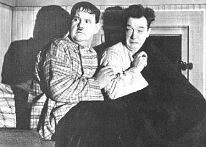
NOTE: Due to my inability to obtain images from “Pardon My Terror,” the images used in this review come from various Schilling & Lane shorts, but not from the film that is being reviewed.

RATING: *** out of ****

PLOT: Gus (Schilling) and Dick (Lane) run the “Wide Awake Detective Agency.” A beautiful woman (Christine McIntyre) hires the pair to find her missing millionaire grandfather (Vernon Dent). At the family home, the daffy detectives run into one unnerving situation after another as they deal with a spooky butler, a femme fatale who serves explosive cocktails, figures lurking in the shadows and more. Can Gus and Dick locate the millionaire before being scared out of their wits?

REVIEW: When it comes to classic comedy duos, there are levels of recognition. Just about everyone knows Laurel & Hardy, Abbott & Costello and Martin & Lewis. When you move on from the general public to bona fide movie buffs, you’ll find some folks who also know Wheeler & Woolsey, Olsen & Johnson and maybe Clark & McCullough. However, to find people who know the teams of Schilling & Lane and Vernon & Quillan, you usually have to find film scholars, or at least those who take their movie-loving hobby beyond the obsession a mere “movie buff” would.

Both Schilling & Lane and Vernon & Quillan were teams created by Columbia Studios for their shorts department. Columbia of course was the home of the mega-popular Three Stooges, but the shorts unit produced many other series featuring all sorts of comic talents. For some reason (speculation is that the studio wanted to duplicate the Stooges’ success, but given how the majority of Columbia’s prefab teams were duos and not trios, I think perhaps they were also hoping they’d capture lightning in a bottle like competitor Hal Roach Studios did when Stan Laurel and Oliver Hardy evolved from solo performers into a team), the unit kept trying to come up with their own daffy duos. This led to all sorts of odd combinations, often pairing such legendary talents as Buster Keaton, Harry Langdon and Shemp Howard with partners who either weren’t as talented or just didn’t mesh well together. The one instance at Columbia where a prominent solo star was teamed with another talent and it worked was when Hugh Herbert and Dudley Dickerson co-starred in some prime horror-comedy shorts. They weren’t billed as a team in the credits, but the shorts played out as if they were a team.

When Columbia paired Schilling and Lane, both had been around and found successful, steady work but neither was a headliner. Gus Schilling’s background was burlesque and the stage, and prior to his shorts with Lane he was a character actor in entries in the Mexican Spitfire and Dr. Kildare film series, appeared in Olsen & Johnson’s “Hellzapoppin’” with Hugh Herbert, and again with Herbert, Edgar Kennedy and Carl “Alfalfa” Switzer in “There’s One Born Every Minute.” His roles weren’t limited to B-movie comedies, however – Schilling also appeared in the high profile Orson Welles films “Citizen Kane” and “Magnificent Ambersons” (Schilling would continue to co-star in films featuring Welles throughout his career). Richard Lane started in the circus and moved to vaudeville. His pre-Schilling & Lane roles also included “Hellzapoppin’” and its follow-up “Crazy House,” series entries in the Mr. Moto, Charlie Chan and Boston Blackie mysteries (where he had the recurring role of Inspector Farraday), a feature each with Jack Benny (“The Horn Blows at Midnight”) and Danny Kaye (“Wonder Man”), three features with Abbott & Costello (“Ride ‘em Cowboy,” “It Ain’t Hay” and “Here Come the Co-Eds”) and a pair with Laurel & Hardy (“A-Haunting We Will Go” and “The Bullfighters”).

The Schilling & Lane team was one of what I like to refer to as the “on-call” or “on-demand” Columbia acts. This meant that the studio called upon the duo whenever they needed to fill a spot in the production schedule. In other words, their series was not “regularly scheduled” – the shorts just happened as they happened – thus the fact that their eleven shorts were spread out over four years. The best of the Columbia “on-call” stars realized that without the benefit of a steady stream of product, audiences wouldn’t have time to get to know their personalities in a progressive fashion. Both Vernon & Quillan and Schilling & Lane were wise enough to maintain broad archetypes that could adapt to any of the situations the scripts required. Lane maintained a sharp, take-charge con-man veneer, while Schilling had the jittery, nervous scaredy cat down pat.

After a year and three shorts, Schilling and Lane were faced with the most “on-demand” assignment of their careers: they were called into action unexpectedly to fill in for the Three Stooges in a script that had been written for the trio but couldn’t go into production because Curly Howard had a stroke. The show had to go on – Columbia didn’t want to waste a script or a slot on the production schedule so they merely shot the short with Schilling and Lane, Schilling was assigned Curly’s dialogue and actions as well as some of Larry's part while Lane was also pressed into double-duty performing both Moe’s and Larry’s parts!

One drawback to the adherence of the original script is that it compromises Richard Lane’s character slightly. In the other shorts, Lane could be pushy toward and occasionally agitated with Gus, but in this short, the script requires Lane to knock Gus around like Moe would Curly and Larry. This works fine in the Stooges world because of the relationship of those characters and the mechanics of the world they inhabit, but it is a bit more jarring in the frantic yet more carefree world usually seen in the Schilling and Lane shorts. It is a tribute to the professionalism of Dick and Gus that their basic personalities could survive this adjustment and they are still likeable despite the lumps Gus takes.

The short opens on an eerie note. We see the millionaire at his desk as a pair of hands emerge from the shadows to strangle him! The millionaire’s grand-daughter Alice enters the room and screams at the sight of her grandfather slumped over his desk. Her screams bring help, but by that time her grandfather has mysteriously disappeared.

This leads into a classic gag that would be reprised by the Stooges when they redid the short as “Who Done It.” We cut to the exterior of the “Wide-Awake Detective Agency.” Inside are Gus and Dick – each wears a pair of fake eyeballs (they almost look like ping-pong balls inserted into their eye sockets) that make them look like they’re awake even though they are snoring away! They are awoken by a “dooting” noise emitted from a monitor on their desk, leading to a great verbal gag (see “BEST DIALOGUE EXCHANGES” below).

The laughs continue in this office setting. Hearing what they think is a customer approaching, Gus and Dick spring into action as if they are busy, with Dick picking up a phone to pretend he’s on the line with another client. “Our fee is five thousand dollars,” he proclaims. Hopes of a new customer are dashed when the boys realize it is simply their landlord Mr. Dugan looking for the rent. Dick pulls out a gun and tells Dugan, “See this gun – we’re gonna’ let you have it! Dugan almost faints but then they tell him they’re letting him keep their guns as collateral. The landlord is dismissive of the guns: “Why these guns won’t even go off!” He throws them to the ground and they do go off, sending bullets flying and ricocheting everywhere! A janitor standing just outside the front door pops his head in, frightened by the racket while the bucket of water he holds suddenly springs multiple leaks – there are holes all over it and the water goes everywhere.

The millionaire’s granddaughter then arrives to bring us back to the plot. She explains her dilemma as she hires Gus and Dick (offering them a substantial reward) and clues them in to the ominous nature of the assignment by asking if they have insurance. When jittery Gus shows doubts about the potentially frightening assignment, Alice exclaims “You’re not afraid, are you?” They have good reason to be afraid as a trio of schemers is soon also revealed to be in the house (the connection these folks have to the millionaire and his granddaughter or the reason why they’re in the same house is never explained). The femme fatale of the group shakes a pill container and exclaims “Two little pills… two little drinks… two ex-detectives!” One of the others tries to show her up – with an electric chair he’s rigged!

Gus Schilling Didk Lane

Gus and Dick show up at the estate and are immediately put ill-at-ease by one of the schemers. “I suppose you’ll want to search for clues,” he says. “Would you rather start where the ghostly white figures were seen or where we found the pool of blood?” When Alice tells Gus and Dick to be careful, the man adds “It’s very hard to get blood stains out of the rugs!”

Gus and Dick come up with a plan: they’ll split up to search for clues, but if one of them is in danger he is to yell “it’s getting warm in here!” The pair then go off their own ways. Gus senses eyes peering at him from behind a painting. He can’t seem to muster up the volume to say “it’s warm in here” – he’s so paralyzed by fear he can only mutter it so he just runs out of the room. This leads to a classic gag where both Gus and Dick knock on hallway walls (answering each other’s knocks) on opposite corners until they meet at the center and then run from each other in fear.

The next bit involves Gus’ encounter with the femme fatale. He runs into a room to find the seductive beauty waiting for him. “I dreamed of a dark handsome man to come and save me,” she purrs. “Well what’s keepin’ him?” Gus answers. As he tries to squirm away, the woman aggressively collars Gus by the neck so hard that it cracks. “What are you, a lady wrestler?!” asks Gus.” Once again Gus is blurting out how “warm” it’s getting – especially with the deadly diva running her fingers through his hair. When she offers him a drink, Gus is skeptical. Falling off the couch, he learns just how right his instincts are as his drink spills onto the floor and bursts into flames!

Gus beats feet, running through the hall hysterically yelling, “Dick! Dick! It’s awful warm in here! A dame just tried to poison me – we gotta’ get outta’ here!” Dick says nothing doing, not with all the reward money at stake.

They resume their search for clues together, with Gus looking through books in a bookcase. As he rearranges each book, a fist flies through from the other side and socks Gus in the nose. “What’s all the racket, lamebrain?” asks Dick in what may be the most obvious “Moe-line” in the script. Gus makes Dick look through the books to prove that he’ll get hit, too… but Dick drops a book – and when he bends down to pick it up, the fist flies out and socks Gus again!

Dick is tired of Gus’ claims of getting hit and starts whapping Gus in different parts of his face saying, “how did it hit you – like this?” This is a prime example of something that would have worked well with Moe and the Stooges, but works less well here. Ultimately, Dick does get whacked by the fist from the bookcase and finally believes.

The butler shows Gus and Dick to their rooms with the classic “Walk this way, please” routine seen in countless old comedy films and later reprised by Mel Brooks in “Young Frankenstein.” The routine is simple: the person saying “walk this way” has a funny way of walking – either their arms are in a weird position or they step in an awkward fashion or some variation thereof. The characters following the person usually give one another a look as if to say, “it’s screwy, but why not?” and proceed to follow that person, mimicking their walk along the way.

Meanwhile, a pair of hands reaches out and grabs Alice, pulling her into the shadows.

We cut back to Dick and Gus in their sleeping quarters. The spooky butler continues to unnerve the pair with inappropriate comments: “I trust you will be comfortable… but I doubt it! After all, this was the master’s room and if the master was murdered I am sure his spirit is somewhere about!” This is performed with all the grand flourish and melodrama of say Vincent Price – delivered for maximum spooky effect. Gus and especially Dick register fear in wonderfully funny ways during this speech – making full use of their mastery of facial expressions and body language. The butler delivers “pleasant dreams” as a punch line.

When Gus & Dick realize they are locked in the bedroom, they start checking for other ways out. Gus opens a closet door and inside is the body of McIntyre’s grandfather. When he calls Dick over the body is gone, but when he opens it a third time the corpse reappears – another time-honored horror-comedy gag.

This leads to a barrage of chaos. Gus and Dick run to the window hoping it can provide a way out. When they pull the shade they see the menacing butler there. They then run through the door and get tangled up in chairs and paintings. Gus then barricades himself in a room and when Dick tries to get into the room Gus clonks him over the head with a flower pot.

The pair then stumble across McIntyre tied to a chair and before long her grandfather comes into the room, alive and well and explaining that he was just “playing dead” to expose the hired help who they suspect are planning to break into the family safe.

Gus and Dick dispatch to the home’s library where they do indeed find the villains trying to break into that safe. A chase ensues with the burliest of the bad guys (Dick Wessel) trying to choke Dick. He is only stopped after about 20 blows to the head with sledgehammer from Gus (as in the Stooges shorts, the sound effect is the sound of a bell and not realistic). The femme fatale then enters with a gun but Jarvis the butler subdues her (yes folks, he was a red herring)!

Gus and Dick get the reward money and as they walk down the hall proclaiming they are “sitting pretty,” they decide to take a load off, sitting in the electrical rigged chair for the short’s “shocking” finale!

The Schilling & Lane shorts are among the best hidden gems you’ll ever see. While “Pardon My Terror” was not conceived for the team and is their only horror-comedy, the duo shines. Despite some uncharacteristic touches more suitable to the Three Stooges, and an emphasis on black comedy over the more traditional visceral horror-comedy touches (the tone here is more like “Abbott & Costello Meet the Killer, Boris Karloff” with its merry mix-up of corpses than the haunted house antics of Bud & Lou’s “Hold That Ghost”) the professionalism, creativity and enthusiasm of Gus and Dick puts this short over big-time. The team is more than deserving of a revival, and “Pardon My Terror” is certainly a fine place to start if you’re just discovering them.

SPOTTED IN THE CAST: Naturally, “Pardon My Terror” is loaded with classic supporting actors from Columbia’s crew of stock players. I’ll concentrate on what amounts to cameos from two of the most prominent of Columbia's contractees.

First off is Emil Sitka playing Dugan the landlord. Sitka appeared in countless shorts at Columbia with The Three Stooges and many of the studio's other featured stars, playing every conceivable character from authority figures to clerks to waiters to friendly uncles and scientists and more. In feature films he appeared in several entries in the Blondie and Bowery Boys series as well as in dramas like “The Blackboard Jungle.” When the Stooges graduated to features in the late 1950s/early 1960s, Emil was on-board making major contributions, especially in “The Three Stooges in Orbit” which featured a major horror-comedy element. Perhaps the best testament to Sitka’s talent and versatility was the fact that after Larry Fine died, Moe considered making Sitka the third Stooge.

Also on hand is Dudley Dickerson as the janitor. A major talent, you can read more about Dudley in my review of Our Gang/The Little Rascals’ “Spooky Hooky” which you can read here.

BEST DIALOGUE EXCHANGES:

LANE (responding to the beeping monitor): That’s the secret code – take it down. What did it say?”

GUS: Doot-doot-doot-doot!”

GUS (upon entering the estate): “Where’s the corpus delicatessen?”

GUS: I gotta’ go back to the office – I forgot something.

DICK: What’d you forget?

GUS: I forgot to stay there!

DICK: You go ahead and I’ll follow you.

GUS: Oh no!

DICK: Okay we’ll do it your way then – you’ll go ahead and I’ll follow you!

BEST GAGS: Most of the gags at the detective agency office are standouts including the fake eyeballs and the guns as collateral. At the estate, Gus’s encounter with the femme fatale as well as Dick and Gus knocking on opposite ends of the wall and the mysterious fist punching through the bookshelf are highlights.

FURTHER READING: Ted Okuda and Edward Watz wrote an indispensible book called “The Columbia Comedy Shorts” that you can order here:


On the internet, there are several excellent articles on Schilling & Lane. One of the best comes from “In the Balcony.” You can read the article here, and you should be visiting that site anyway – it is an oasis for classic movie fans. You’ll also want to check out Pete Kelly’s Blog here and Thrilling Days of Yesteryear here. The Three Stooges fan site features a quote from director Ed Bernds about the script - read it here. Last but not least, you may want to visit The Columbia Shorts Department – Greg Hilbrich’s excellent site dedicated to the fun and frolics of this studio that gave the world The Three Stooges and so much more.

WATCH THE FILM: Enjoy this clip from the short!

Monday, February 20, 2012

THE GHOST BREAKERS (1940)

Ghost Breakers poster

RATING: *** & ½ out of ****

PLOT: When Mary Carter (Paulette Goddard) inherits a castle on a Cuban island, her attempts to claim the inheritance are met with death threats and scares. Tales of ghosts and zombies are meant to frighten and deter her, both before she leaves for Cuba and after she gets there. Meanwhile, radio announcer Larry Lawrence (Bob Hope), a muckraker whose favorite targets are local racketeers opens his mouth a little too wide during a broadcast and now the thugs are after him! A mix-up with a trunk lands Larry literally on the same boat as Mary… and figuratively in the same boat in terms of the terrifying trouble that lies ahead! The pair, accompanied by erstwhile valet and assistant Alex (Willie Best) explore the castle grounds and do indeed come face-to-face with ghosts, zombies and a murderously spooky plot to keep the castle and its treasures out of Mary’s hands!

REVIEW: “The Ghost Breakers” represents a watershed moment in the history of horror-comedies. While its legitimately scary zombie has an antecedent in the sea hag from Hugh Herbert-Allen Jenkins’ “Sh! The Octopus” it ups the scare ante considerably and kicks off the 1940s with a template that would go on to serve many of the funny fright flicks to follow, whether sporting legitimate terrors (most notably Brown & Carney’s “Zombies on Broadway” and the all-time classic, “Abbott & Costello Meet Frankenstein”) or trumped-up terrors (like the Kay Kyser starrer “You’ll Find Out” which followed five months later or Abbott & Costello’s “Hold That Ghost,” which appeared a year later). Specifically, it sets the tone for 1940s horror-comedies and even comedies in general to one where flippant heroes can be both brash and insulting in the face of terror regardless of whether they are being scared out of their wits (a sharp contrast from the 1930s’ genteel Laurel & Hardy fright reactions or the absurdist machinations of a team like Wheeler & Woolsey).

In addition to the ramped-up scare quotient, the amount of verbal barbs and one-liners has also noticeably increased over 1930s’ efforts. Despite a lengthy detour or two, it has one of the best scripts ever conceived for a horror-comedy, spookily effective direction from George Marshall, a resourceful and compelling heroine in Paulette Goddard, a truly horrific zombie monster portrayed by Noble Johnson and superlative clowning and jokes from comedy legends Bob Hope and Willie Best. All this plus a top-notch supporting cast full of surprises like an early featured part for Anthony Quinn and Jack Norton in a brief bit doing what he did best – playing the befuddled drunk.

The film hits the ground running with a thunderstorm raging through New York City. In the hotel room of Paulette Goddard and her suave companion, the lights have gone out. When Paulette calls to room service to report the trouble, she learns that the whole building’s electricity has gone down in the storm. This helps clue in the audience to the plot immediately, as Paulette asks the front desk to send up some candles so she can see what she’s doing while packing for her trip to Cuba. When her companion, Mr. Havez of the Cuban consulate (there to witness the transfer of Paulette’s great-great grandfather’s castle to her) notes that the lights have seemed to go out throughout the whole city, the crack screenplay provides an immediate insight into Paulette’s character: as lightning races across the sky outside her window and thunder roars bombastically, an expression of total adrenaline and satisfaction lights up her face. “Exciting, isn’t it?” she declares. Paulette will be a reluctant damsel in distress at best, and the perfect counterpoint to Bob Hope’s patented coward, who’s more apt to be out to save his own skin when faced with trouble.

The first portion of the screenplay accomplishes what the script for “Abbott & Costello Meet Frankenstein” would eight years later: it deftly sets up a backstory with an economy of footage by making the reveal of that backstory an organic part of the exposition. Within the first several minutes we learn Paulette Goddard’s character Mary is heir to an ancestral estate on an island just off of Cuba (ominously named “Black Island”). We also learn that the castle on the estate is rumored to be haunted by the ghosts of Mary’s ancestors. There are several parties interested in the transaction – among them are the aforementioned Mr. Havez from the Cuban consulate, and Mr. Parada who delivers the deed to Mary but is hoping she’ll just sell the property to him. Last but not least is a mysterious telephone caller (played by Anthony Quinn in an early role) who warns Mary of the danger ahead. And just as the “Meet Frankenstein” script provides incidents that would naturally culminate in the main characters coming together, so too does “The Ghost Breakers” screenplay deliver a reason for Bob Hope’s path to cross Paulette’s.

(NOTE: To make this review easier to follow, from here on out I’ll be mentioning Bob Hope, Paulette Goddard and Willie Best by their real names instead of their character names.)

Unfortunately, after this great opening the script gets bogged down a little in its details. It’s entertaining enough in the unfolding, but you do wish the film would get to its next batch of scary bits quicker than it does. This demerit coupled with a few unfortunately stereotypical barbs at the expense of African-American performer Best keeps me from giving the film a full four stars, but it’s still a classic. The blame really belongs to the two subplots of shady characters trying to manipulate Paulette into selling her inheritance and a murder involving the aforementioned racketeers (or is it) that Hope manages to accidentally witness. How does this all tie together? Goddard just happens to live (or is at least staying) in the same upscale hotel that serves as the racketeers’ headquarters.

Some background: a common phenomenon of the 1930s and ‘40s was the “muckraking radio reporter” that routinely dished dirt about local mobsters over the airwaves. How did they get the dirt? There was usually a disgruntled lackey somewhere within “the organization” willing to spill the beans for a price. Most of the time the egomaniacal mobsters didn’t care about the gossip as long as it made them sound good… or at least tough and in control of their rackets. Basically, all a reporter had to do to preserve his life was not rub the thugs the wrong way – which meant that they pretty much had to deliver whatever the goons handed to them, report it straight, do no editorializing, don’t get the story wrong and above all else, don’t insult the gangsters! This last actually serves as the plot catalyst for another classic horror-comedy, Brown & Carney’s “Zombies on Broadway.” In “Ghost Breakers,” Hope unwittingly breaks all those rules by relaying a spurious tip from “Raspy Kelly” about notorious crime lord “Frenchy” Duval. When Hope asks Kelly if his mob knows he’s feeding these stories, Kelly just brushes off the question. After Hope’s latest dish on Duval, the maligned mug requests a meeting with Hope, promising to “give it to him straight.” Its while on his way to confer with the disgruntled hood that Hope realizes the real danger he’s in.

The screenplay serves a dual purpose: in addition to telling a compelling tale where the audience can root for the heroes to overcome the obstacles before them, it also both capitalizes on and adds to the Bob Hope persona. Hope was already a hit on the vaudeville and Broadway stages as well as on radio, and had dabbled in movies, most notably short subjects and a few features before his breakout role in 1939’s “The Cat and the Canary.” It was based on the 1922 play of the same name, discussed previously here as a horror-comedy template. Following just a year after “Cat,” “The Ghost Breakers” has the feel of an unofficial sequel to the earlier film – sharing both Hope and Goddard as its leads and like its predecessor, its feet firmly planted in classic horror-comedy territory. Hope’s character – full of bravura one moment and scared witless the next – was key. In later years instances of “self-preservation” would be added to the mix making the character a comedy relation to Daffy Duck, Basil Fawlty and George Costanza. And yet Hope was much more endearing than any of the above.

So the script gives the Hope character a chance to gain further momentum and build familiarity with audiences at every turn. For example, Bob mentions that every time there’s a storm something happens to him – “You remember that Greek girl in Los Angeles” and “that dame in Cincinatti” and “the redhead in Poughkeepsie.” It would become a Hope hallmark to be self-deprecating and yet also cast his own character in a spurious light. Hope also questions the radio station’s decision to run on auxiliary power during the blackout so he can do his broadcast. “Did they get an okay from heaven,” he sarcastically asks Best, pointing out another facet of the Hope movie character – a bit weary of authority, but in a more general (and genteel) sense than a rebellious misanthrope character like the one often played by W.C. Fields or an anarchic iconoclast like Groucho Marx. While Hope wouldn’t go beyond the occasional snarky comment, anything else would require too much work, especially starting a revolution.

It doesn’t make much sense that Hope goes to Frenchy’s hotel after getting such a threatening phone call from the hood, but it does help move the plot along. An effectively suspenseful scene follows where the lights flicker on and off due to the storm, Bob ducks into a room, guns go off (including Hope’s) and a man is shot dead in the hallway. If you stumbled upon this scene on a late night TV broadcast of the film, you might wonder, “what is Bob Hope doing in a gangster movie?!” Yes, multiple guns are fired and in the excitement, Bob’s gun goes off, too leading him to believe he just killed one of Frenchy Duval’s men. He ducks into Paulette’s room, where they exchange a barrage of snappy banter loaded with Hope’s one-liners and deprecating comments. When the police come to search the room, Hope hides in Paulette’s trunk… conveniently landing him on the same boat to Cuba as Paulette!

There’s one complication: the dead man is identified as Ramon Mederos – the same man who telephoned Paulette to warn her of imminent danger! Played by Anthony Quinn, and possessing a secret that will keep him in play throughout the rest of the film, Mederos in many ways foreshadows the Larry Talbot Wolf Man character as portrayed by Lon Chaney, Jr. in “Abbott & Costello Meet Frankenstein.” The two actors have similar features and they carry their characters in similar ways – they are earnest yet foreboding.

Bob Hope Willie Best Ghost Breakers

Willie Best is fantastic in the film. While he’s in the “servant” role he carries himself with such assurance that it’s easy to forget the standing of his character. The scene where Best goes to the ship’s cargo hold to find the trunk that Hope is hiding in is a showcase for Best’s visual and verbal talents. His body language and facial expressions as he approaches each trunk coupled with some muttered asides are funny indeed. He even starts singing a song about his missing boss, “Oh Mr. Larry was a…” When he comes face-to-face with a cop the script (or maybe it’s an ad lib?) affords Best’s character a sublime moment to kid the stereotyped roles he and fellow comics Mantan Moreland and Dudley Dickerson often found themselves in: “I just love to fool around with baggage – I used to be a porter! I been around trunks for 20 years now…”

The scene only gets better as one of the silver screen’s most prolific “perennial drunks” come along to find Best talking to the trunk. Naturally Norton pegs Best as a master ventriloquist! In an hysterical drunken drawl, Norton keeps verbally expressing his amazement with lines like, “It’s marvelous! I never saw your lips move one bit! I’m going to stand right here until you do it again! C’mon, do it again! Best, already beyond nervous over Hope’s situation bellows, “Mister, I ain’t always got the power!” Despite Best’s denials Hope’s cries of “get me out of here” leave Norton convinced Best is continuously doing the bit. Norton insists that Best and the trunk come back to the mainland with him so he can “pass the hat” and “make a fortune” on the “act!”

More plot complications ensue – it seems all involved (and the two that wished they weren’t – Hope and Best) end up on this boat to Cuba. Hope is ultimately extricated from the trunk but must go back to hiding in it when Mr. Parada comes into the stateroom asking Paulette who made a call to her. Meanwhile, a note is delivered to her reading, “Death waits for you on Black Isand.” Paulette tells Parada that Ramon Maderos was the one who called. Parada asks if Maderos mentioned him and then reveals that he’s also sailing to Black Island. Paulette spirits Parada away so he won’t discover Hope, Bob discovers the threatening note that was delivered to her. Citing the fact that Paulette saved his own life, Hope vows to help her out, with Best’s help. Not without trepidation, however: when Best asks Hope if he’s scared, Bob replies, “I’m shakin’ so hard, the water on my knee just splashed!”

Out on the deck, Parada continues to try to dissuade Paulette from taking possession of the castle. His dialogue is full of ominous foreshadow. “It may be some time before you see New York again,” he says. He also mentions that “There’s a great deal of fog on Black Island. At times it completely shrouds the castle.” Paulette remains tough and determined: “You can’t discourage me. I’m going to have fun in Cuba.” Parada presses her that there are things the travel brochures don’t show… like ghosts and zombies! “I was a skeptic too until I saw with my own eyes this malignant force at work in your castle.” He weaves a tale that Paulette’s ancestor who built the castle was a slave trader and how it’s besieged by all the lost souls of those “tortured, starved and murdered” in the castle dungeon, now out for revenge.

Meanwhile, Hope has wandered on deck. “Pardon me – am I protruding?” Hope, having overheard the discussion about ghosts barges in on the conversation and introduces himself to Parada as being a “ghost breaker.” He explains that he takes “family skeletons” out of the closet to “dust them off.” He goes on to state that he “explain(s) mysteries that people don’t want explained.” It’s an interesting move for the otherwise cowardly Hope – some bravado to rattle Parada. And really not far from the truth when you consider what his job as a muckraking radio reporter entails!

Hope’s bluff works well, as Parada lets out some key information that he “believes” the castle is haunted by just one ghost, the spirit of Don Santiago. “Does he appear nightly, or just Sundays and holidays,” Hope quips.

Bob is committed to seeing the situation through, and as the intrepid trio review the facts, Bob makes an interesting observation about Parada – that he looks guilty but “in situations like these you never suspect the guy that looks guilty.” He also makes note that all the interested parties have some sort of angle… and it hasn’t gone well for most of them. Hope goes through the list: “First Mederos – somebody found out he was about to tell you something important – exit Mederos” and continues until he gets to his own troubles).

More intrigue ensues on the ship – everyone seems to be vying for Paulette’s attentions, and not all in a good way. When Paulette returns to her room there’s a knife pinned to the door – on the inside – with something fuzzy hanging from it. A little man is seen on the other side of the door listening, and he’s stopped by a man named Geoff Montgomery, who is introduced during this scene. Apparently Geoff and Paulette know each other from a “six day bike race.” He identifies the ominous object hanging from the door as a “voodoo ou-anga”. He explains that they’re prepared by voodoo priests and often bring good luck, but this particular one is a “death ou-anga."

Meanwhile Bob uses more psychology on Parada, telling him he plans to go to the castle before Mary does, and that he’ll be so scared that if he sees any “ghosts” he’s liable to take a shot at one. He ditches dinner with Paulette and Montgomery, who underscores that many mysterious things happen on the island. Paulette gets a taste when she spots what looks like Ramon Mederos. She wonders aloud if he’s a ghost. The man approaches her and reveals that he’s Francisco Mederos – Ramon’s twin brother. He presses her to tell him who killed Ramon and why.

There are other little details and small talk amongst characters but once that passes we finally get to the “meat” of the film: Hope and Best row their way to Black Island. No sooner do they dock than they encounter a zombie. A particularly horrific one at that – among the scarier creatures to appear in a horror-comedy and about the most startling monster since the sea hag-witch in “Sh! The Octopus.” The housekeeper (credited as “Mother Zombie”) shoos them away but that doesn’t stop the duo from approaching the castle entrance to investigate further.

It’s in the castle that “The Ghost Breakers” pulls out all the stops. There are so many spooky and scary touches that if the ample jokes didn’t already ensure this film’s placement in the horror-comedy hall of fame the effectively creepy bits would. Here’s a run-down of what Hope and Best come up against:

• Bats, flying right at them
• Cobwebbed chandeliers
• Their every word echoed
• Dark corridors
• A grandfather clock with jangly chimes
• A creaking door
• Squawking birds and screeching wildlife
• An old organ
• Disembodied voices and sneezes
• Decorative suits of armor with bad guys hiding inside
• Hidden panels

Answers sort of start falling into place when Hope and Best come upon a life-sized portrait that looks exactly like Paulette, they note the nameplate identifies the woman as “Maria Ysobel Sebastian.” Hope finds an old trunk and as he looks through it, the shadow of a mysterious figure is seen on the wall behind him. Meanwhile, while Best keeps watch downstairs he sees the translucent figure of a ghost rise from another trunk! Hope investigates and finds nothing but a skeleton inside that trunk. Best is convinced they are dealing with real live (real dead?) ghosts; Hope is not so sure and thinks it’s a ruse to scare them off.

Meanwhile, Paulette swims to the island to begin her own investigation in the castle… and comes face to face with the zombie monster! She manages to evade the creature and hide away in one of the castle’s many rooms.

Paulette Goddard

A quick note about Paulette Goddard. Then Charlie Chaplin’s on-and-off-screen leading lady, the producers seem fully aware of what an asset they have in Paulette not just from an acting standpoint but also her beauty. Her bathing suit not only accentuates her figure but remains on during the climax, covered only by a flimsy white robe that is partially torn while fleeing from the zombie. It seems the producers figured they might as well throw in some sex appeal to keep audiences engaged in-between the frantic comic antics of Hope and Best and the eerie scare scenes and special effects.

The conclusion of the film is a whirlwind. There are so many great twists and turns and surprises that I really don’t want to spoil it – it really needs to be seen and I wouldn’t want to ruin a great viewing experience for anyone. Suffice to say that both Paulette and Best contribute greatly to the routing of the villains; she with a marvelous masquerade that literally stops the zombie in its tracks and he with a well-timed (though unintentionally so) push of a trap door’s button.

Above I stated how the Anthony Quinn character and the screenplay’s structure seem to have had an influence on “Abbott & Costello Meet Frankenstein.” It bears mention that there are also great similarities to some of the musical cues in both films’ scores as well as scenes at the rickety island dock that remind one of “Meet Frankenstein’s” La Mirada, Florida pier.

All in all, “The Ghost Breakers” is a crowd-pleasing popcorn movie with a lot to offer audiences patient enough to follow its labyrinthine plot. It delivers in all areas. Hope, Best and Norton elicit some of the biggest laughs of their formidable careers. Goddard emerges as one of if not the most memorable heroine in the classic horror-comedy genre. The scares are not only genuine but the overall tone of dread is consistent – consider even the scenes on the boat to Cuba, enhanced by highly effective, shadowy, mist-shrouded black and white cinematography. Hope and Goddard come off as a convincing romantic couple-in-the-making (bolstered by the fact that Hope could more easily pass as a leading man than some of the less attractive male comics – his charm in the scene where he and Paulette dance in her stateroom is ingratiating).

I mentioned earlier that despite all it has going for it, I couldn’t award “The Ghost Breakers” a complete four out of four star rating. But it really is a close call. If there were a way to get the main players to the spooky island sooner and provide additional scary complications that could have helped. There would still be the problem of the racial jokes, however. This pops up a lot in classic horror-comedies, and it’s a bit of a dichotomy: while Best is playing Hope’s valet, their relationship is more one of close, personal friends who have each other’s backs. And yet every 16th one-liner the writers feel pressed to throw in a racial comment as if to say, “don’t get too comfortable, Willie – know your place.” With the over-abundance of other jokes in the film, the racially-tinged quips are just unnecessary and as a result help bring the film down a notch.

Last but not least, it’s never really clear whether the zombie was real or not – the film implies that the truth points one way, but you’ll still be wondering whether that way is true or not (especially in light of the zombie’s reaction to Paulette’s masquerade). The ghost, however… well, Anthony Quinn assures Bob Hope (and the audience) that the ghost is very real. Making it one of the few films of the ‘40s with “Ghost” in the title to actually feature a “real” ghost in the film!

SPOTTED IN THE CAST: Robert Ryan, who often played tough, conflicted heroes and villains in westerns, film noir and war movies is seen here in his first film as an ambulance driver.

BEST DIALOGUE EXCHANGES:

“The Ghost Breakers” might hold a record for number of one-liners in a film. I’m tempted to share them all but that not only would make the review longer than it needs to be but also rob you of the joy of hearing the jokes fresh for yourself. Here are some of the standouts:

BOB HOPE (taking candle from Best during the blackout): Look, gimme the candle and you fall over the furniture for a while!

BOB HOPE (after flash of lightning and sound of thunder): Basil Rathbone must be giving a party!

WILLIE BEST (worried about Hope who has angered so many gangsters): I expect some of these mornings when I come to get you outta’ the bed I’ll have to pull the sheet up instead of down.

HOPE (ducking into Paulette’s apartment after witnessing a murder): Don’t talk and especially don’t scream – if there’s going to be any hysterics around here, I’ll have them!

BEST (to Hope locked in trunk): Keep your chin up Mr. Larry.

HOPE: I can’t, my knees are in the way!

BEST: Did you shoot that man in the hotel with my gun?

HOPE: Yes, I confess.

BEST: No you didn’t – my gun’s a .32, and that man was shot with a .38.

HOPE: 32-38. That’s six points in my favor!

HOPE: If a couple of fellows come running down the stairs in a few minutes let the first one go – that’ll be me.

BEST: If somebody passes you, that’ll be me.

BEST (when he and Hope find windowed coffin of Maria Sebastian): Boss, is that a mummy?

HOPE: Yes, Miss Carter’s great-great-grandmummy!

HOPE: We’re not gonna’ get hurt unless we find the real secret of this place.

BEST: Well why do we keep lookin’ for it?!

In this Internet age, one verbal exchange in particular from “Ghost Breakers” has taken on a life of its own, being shared countless times (a “viral video” created in 1940). Ironically, it’s doubtful the joke would have the same punchline were the film released today – in fact I’d venture to guess many of today’s screenwriters would provide the opposite punchline:

MONTGOMERY: …a zombie has no will of his own. You see them sometimes walking around blindly with dead eyes, following orders, not knowing what they do, not caring.

HOPE: You mean like Democrats?

BEST VISUAL GAGS:

Hope channels his inner Red Skelton for a very funny crouch-walk around Paulette’s stateroom once freed from the shipping crate. He’s been cramped up in the crate so long he’s having a hard time straightening out, and when Best comes along he even opens the door in the crouched position! When Best helps Hope to his feet, Bob quips “all we need is a grind organ and a tin cup!”

When Best sees the ghost he backs up against the wall and his bowler derby rises above his head on an angle, a classic sight gag favored by the likes of Stan Laurel and other vintage comics from the 1920s and ‘30s.

When Hope opens the door to the grandfather clock he finds Best inside, shivering away (funny), his face a pale pallor (not so funny – it’s one of those “the black man is so scared he’s turned white” gags).

FURTHER READING:

There are a lot of reviews of this film floating around the internet. One of the best is from the B-Movie Central site which you can read when you click here.

My friend James L. Neibaur, a celebrated film historian who has written and co-written several books on classic film comedy has among them authored “The Bob Hope Films” which you can buy here.

BUY THE FILM:

The film is available on DVD from several online retailers as both as a stand-alone disc and also as part of a box set called “Thanks for the Memories” that includes Hope’s other classic horror-comedy, “The Cat & the Canary” and four other films.

WATCH THE FILM:

Enjoy the trailer to “The Ghost Breakers” here: